The 'AI-Powered Customer Journey Mapping' Playbook for 2026: Beyond Linear Funnels to Predictive Paths
Digital Marketing · By Futurise Solutions ·
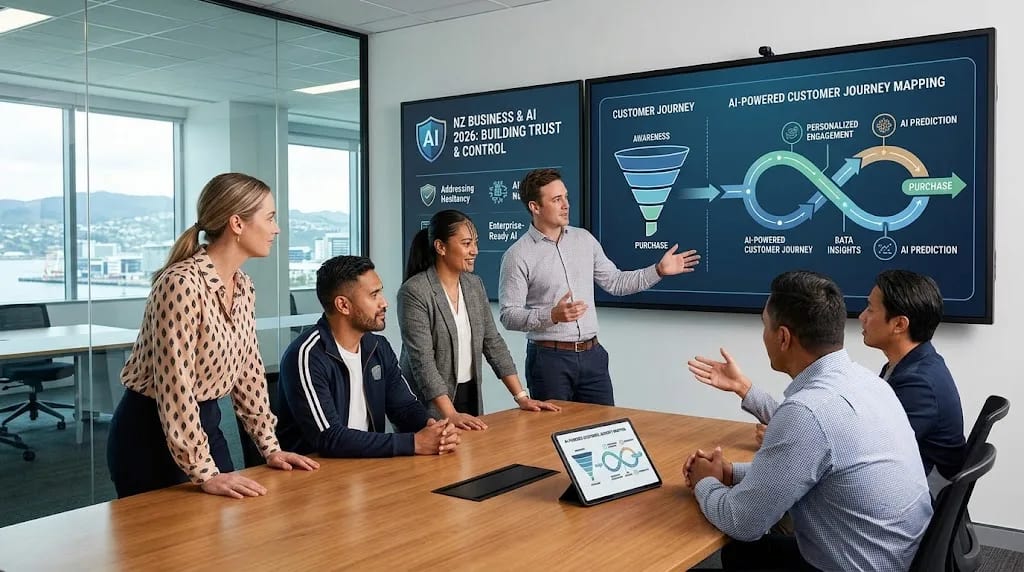
Discover the 'AI-Powered Customer Journey Mapping' Playbook for 2026, transforming linear funnels into predictive paths for New Zealand businesses.
Are your marketing efforts in New Zealand still stuck in the past, optimising for a customer funnel that no longer exists? In 2026, the traditional, linear customer journey is a relic, replaced by a complex, multi-directional labyrinth of touchpoints. For businesses across Wellington, Auckland, and Christchurch, understanding and influencing this new reality is not just an advantage – it's a survival imperative.
The problem is clear: customers are interacting with brands across an ever-growing array of channels, often switching platforms, devices, and even intent mid-journey. This fragmentation makes it incredibly difficult to deliver a consistent, personalised experience, leading to missed opportunities and frustrated customers. Your business needs a way to not just observe these journeys but to anticipate and adapt to them in real-time.
New Zealand has a thriving startup ecosystem and a rapidly growing digital economy, valued at an estimated NZ$4.2 billion. Kiwi businesses are early adopters of technology and increasingly turning to custom software to compete globally. This innovative spirit demands equally innovative marketing strategies, moving beyond reactive campaigns to proactive, predictive engagement. The future of customer experience lies in leveraging artificial intelligence to transform chaotic journeys into intelligently orchestrated, highly personalised paths.
In this guide, we cover the 'AI-Powered Customer Journey Mapping' Playbook for 2026, explaining how your New Zealand business can move beyond simple funnels to predictive, non-linear customer paths, ensuring you stay ahead in a competitive digital landscape.
Table of Contents
- What is AI-Powered Customer Journey Mapping for 2026?
- Why New Zealand Businesses Need AI Customer Journey Mapping in 2026
- The Evolution from Linear Funnels to Predictive Customer Paths
- Key AI Technologies Driving Predictive Customer Journeys
- Practical Steps for Implementing AI-Powered Customer Journey Mapping
- Benefits & ROI for New Zealand Businesses
- Common Mistakes to Avoid in AI Customer Journey Mapping
- Choosing the Right Digital Marketing Partner for AI Solutions in New Zealand
- FAQ Section
- Why Choose Futurise Solutions?
What is AI-Powered Customer Journey Mapping for 2026?
AI customer journey mapping 2026 is the advanced application of artificial intelligence and machine learning to understand, predict, and optimise the complex, often non-linear interactions customers have with a brand across all touchpoints. It moves beyond static visualisations to dynamic, data-driven systems that learn and adapt.
Beyond Traditional Mapping
Traditional customer journey maps are typically static diagrams, based on assumptions and historical data. They often depict a linear path from awareness to purchase. In contrast, AI-powered mapping is a living, breathing system. It continuously processes vast datasets to reveal actual non-linear customer journeys.
Predictive Customer Paths
The core innovation lies in its predictive capability. AI analyzes historical and real-time data to anticipate customer needs, behaviors, and next best actions. This allows your business to proactively intervene with relevant content or offers, guiding customers along predictive customer paths rather than reacting to their past actions.
AI-Driven Customer Experience
This approach fundamentally transforms AI-driven customer experience. It's about delivering hyper-personalised interactions at scale, ensuring every customer feels understood and valued. This level of personalisation is impossible without AI's ability to process and interpret massive amounts of individual behavioural data.
Why New Zealand Businesses Need AI Customer Journey Mapping in 2026
New Zealand businesses, from startups in Wellington to established enterprises in Auckland, operate in a unique and competitive environment. Leveraging advanced AI for customer experience is no longer a luxury but a necessity.
Navigating Fragmented Customer Journeys
Today's customers engage across websites, social media, mobile apps, email, chatbots, and physical stores. These interactions rarely follow a neat, sequential order. AI helps untangle these fragmented paths, providing a cohesive view that human analysts simply cannot achieve. This is crucial for maintaining relevance in a market where customer attention is a premium.
Meeting High Customer Expectations
Kiwi consumers, like their global counterparts, expect seamless, personalised experiences. They anticipate brands to understand their preferences and provide relevant solutions. Generic messaging and one-size-fits-all approaches lead to disengagement and lost sales. AI-powered mapping enables the deep personalisation required to meet these elevated expectations.
Gaining a Competitive Edge Locally and Globally
New Zealand's digital economy is growing rapidly, fostering intense competition. Businesses that master AI for customer lifecycle management will gain a significant advantage, retaining customers longer and acquiring new ones more efficiently. For those looking to compete on the global stage, especially with custom software solutions, this capability is non-negotiable. It allows you to offer an experience that rivals larger international players.
The Evolution from Linear Funnels to Predictive Customer Paths
The shift from traditional marketing funnels to dynamic, AI-driven customer journeys represents a fundamental paradigm change. It's about understanding that customers don't always follow a neat, prescribed path.
The Limitations of Linear Funnels
Traditional funnels assume a sequential journey: Awareness, Interest, Desire, Action. This model, while useful for initial conceptualization, fails to account for modern realities. Customers jump stages, loop back, or exit and re-enter at different points. They might research a product on social media, add it to a cart, abandon it, then return weeks later via an email promotion.
Embracing Non-Linear Customer Journeys
Non-linear customer journeys are the norm in 2026. A customer might discover your brand through an influencer, browse a product on your app, then seek a review on an external forum, and finally make a purchase in-store. AI-powered mapping helps visualise and understand these complex, often chaotic, paths. It identifies the critical micro-moments and touchpoints that influence decisions, regardless of their position in a theoretical funnel.
Proactive Engagement through Predictive Analytics
The real power of AI lies in its ability to move from reactive observation to predictive customer paths. By analyzing vast datasets—including browsing history, purchase patterns, search queries, and even sentiment analysis—AI can predict a customer's likelihood to convert, churn, or engage with specific content. This allows your business to proactively deliver the right message, at the right time, on the right channel, optimising every interaction for a better outcome.
Key AI Technologies Driving Predictive Customer Journeys
The sophistication of AI-powered customer journey mapping relies on several advanced technologies working in concert. These tools allow for deep data analysis and intelligent automation.
Machine Learning (ML) for Pattern Recognition
ML algorithms are at the heart of predictive mapping. They analyse massive datasets to identify patterns in customer behaviour that are invisible to the human eye. This includes identifying common predictive customer paths, understanding the triggers for engagement or disengagement, and predicting future actions. ML models continuously learn and improve as more data becomes available, making predictions increasingly accurate.
Natural Language Processing (NLP) for Sentiment and Intent
Customer intent prediction AI heavily relies on Natural Language Processing. NLP allows AI to understand and interpret human language from various sources: customer reviews, social media comments, chatbot conversations, and support tickets. By analysing text, NLP can gauge sentiment, identify pain points, and infer customer intent, providing critical insights into their emotional state and what they are trying to achieve.
Data Orchestration and Real-time Analytics
For omnichannel customer journey AI to be effective, data from all touchpoints must be integrated and analysed in real-time. This requires robust data orchestration platforms that can collect, clean, and unify data from CRM systems, marketing automation platforms, website analytics, and more. Real-time analytics ensure that insights are fresh and actionable, enabling immediate adjustments to customer interactions. At Futurise Solutions, we specialise in AI & ML Solutions that handle complex data orchestration.
Dynamic Customer Segmentation
Traditional segmentation often groups customers into broad categories. AI enables dynamic customer segmentation, creating highly granular and fluid segments based on real-time behaviour, preferences, and predicted intent. These segments are not static; they evolve as the customer journey progresses, allowing for even more precise personalisation and targeted marketing efforts.
Practical Steps for Implementing AI-Powered Customer Journey Mapping
Implementing AI-powered customer journey mapping requires a strategic approach, integrating technology with business objectives. Here’s how your New Zealand business can get started.
Define Your Objectives and Data Sources
Before diving into technology, clearly define what you want to achieve. Are you looking to reduce churn, increase conversion rates, or improve customer satisfaction? Identify all relevant data sources across your organisation, from your CRM and marketing automation platforms to website analytics and customer service interactions. Consider data from your Web Development Services and App Development Services as well.
Select the Right AI Tools and Platforms
Evaluate AI-driven platforms that specialise in customer journey analytics and orchestration. Look for solutions that offer robust machine learning capabilities, NLP for sentiment analysis, and seamless integration with your existing tech stack. Consider partnering with experts like Futurise Solutions for custom AI & ML Solutions tailored to your specific needs.
Integrate Data and Establish a Single Customer View
This is a critical step. All disparate data sources must be integrated to create a unified, single customer view. This allows the AI to gain a holistic understanding of each customer's interactions across all channels. Ensure compliance with the New Zealand Privacy Act 2020 when collecting and processing customer data, prioritising transparency and data security.
Start Small, Iterate, and Scale
Begin with a pilot project focusing on a specific segment or journey stage. This allows you to test the waters, refine your approach, and demonstrate early wins. Continuously monitor performance, gather feedback, and iterate on your AI models and strategies. As you gain confidence and see results, gradually scale your implementation across more customer segments and journey stages. Our SaaS Platform Scale Case Study demonstrates our ability to help businesses grow effectively.
Benefits & ROI for New Zealand Businesses
The adoption of AI-powered customer journey mapping offers significant benefits and a strong return on investment (ROI) for New Zealand businesses looking to thrive in 2026.
Enhanced Customer Satisfaction and Loyalty
By delivering truly personalised and proactive experiences, your business will foster deeper customer connections. Customers feel understood and valued, leading to increased satisfaction and long-term loyalty. This reduces churn and creates advocates for your brand.
Increased Conversion Rates and Revenue
AI customer journey mapping 2026 identifies and optimises critical conversion points across the entire customer lifecycle. By predicting intent and delivering relevant offers at the right time, businesses can significantly improve conversion rates, driving higher revenue. Imagine the impact of predicting when a customer is about to abandon their cart and proactively offering a targeted incentive.
Optimised Marketing Spend and Efficiency
AI helps allocate marketing resources more effectively by identifying the most impactful channels and messages. It reduces wasted spend on irrelevant campaigns and automates many aspects of personalisation, freeing up your marketing team to focus on strategic initiatives. This leads to a more efficient and productive marketing operation.
Deeper Insights into Customer Behavior
Beyond just optimising journeys, AI provides unprecedented insights into how your customers truly behave. It uncovers hidden patterns, identifies emerging trends, and highlights areas for product or service improvement. This continuous learning fuels better decision-making across your entire organisation. Our AI Support Agent Case Study showcases how AI can deliver profound insights.
Common Mistakes to Avoid in AI Customer Journey Mapping
While the potential of AI customer journey mapping is immense, several pitfalls can hinder your success. Being aware of these common mistakes can save your New Zealand business time and resources.
Over-reliance on Technology Without Strategy
Simply acquiring AI tools without a clear strategy is a recipe for failure. Technology is an enabler, not a silver bullet. Your business needs a well-defined understanding of its marketing objectives, customer segments, and desired outcomes before implementing AI solutions. The strategy should always drive the technology, not the other way around.
Neglecting Data Quality and Integration
AI models are only as good as the data they're fed. Poor data quality (incomplete, inaccurate, or inconsistent data) will lead to flawed insights and ineffective predictions. Furthermore, failing to integrate data from all touchpoints creates a fragmented view, undermining the core benefit of omnichannel customer journey AI. Invest in data governance and ensure seamless data pipelines.
Ignoring the Human Element
While AI automates and predicts, the human touch remains vital. AI should augment, not replace, human creativity, empathy, and strategic oversight. It's crucial to have skilled marketers and strategists who can interpret AI insights, refine models, and craft compelling narratives that resonate with your audience. Don't let the technology overshadow the importance of genuine human connection.
Failing to Adapt to Regulatory Changes
The digital landscape is constantly evolving, and so are privacy regulations. In New Zealand, adhering to the New Zealand Privacy Act 2020 is paramount. Failing to ensure your AI-powered mapping practices are compliant with data privacy laws can lead to significant penalties and damage to your brand reputation. Always prioritise ethical AI use and data security.
Choosing the Right Digital Marketing Partner for AI Solutions in New Zealand
Selecting the right partner is crucial for successfully implementing AI customer journey mapping 2026. For New Zealand businesses, finding a local or globally experienced agency with a strong understanding of AI and your market is key.
Expertise in AI & Machine Learning
Look for a partner with proven expertise in AI & ML Solutions. They should have a deep understanding of how machine learning algorithms work, how to train models, and how to integrate AI into existing systems. Ask for case studies, like our AI Support Agent Case Study, that demonstrate their capabilities in this area.
Holistic Digital Marketing Competence
AI customer journey mapping doesn't exist in a vacuum. Your partner should also have strong capabilities in broader Digital Marketing Services, including SEO, content marketing, PPC, and conversion rate optimisation. This ensures that AI insights are effectively translated into actionable marketing campaigns across all channels. Our SaaS SEO Growth Case Study highlights our integrated approach.
Local Market Understanding
While AI principles are universal, the application benefits from local context. A partner with experience working with New Zealand businesses will better understand local consumer behaviour, market trends, and regulatory nuances. Futurise Solutions, based in Wellington, has a deep appreciation for the unique challenges and opportunities within the Kiwi market.
A Track Record of Innovation and Results
Seek a partner that demonstrates innovation and a results-driven approach. They should be able to show you how they've helped other businesses achieve measurable improvements in customer experience, conversion rates, and ROI. Review their Portfolio and client testimonials to gauge their effectiveness.
Pricing in New Zealand (2026)
Understanding the investment required for robust digital marketing, especially with advanced AI capabilities, is essential. Here’s a general overview of pricing for various digital marketing packages in New Zealand for 2026. Keep in mind that costs can vary significantly based on scope, complexity, and the level of AI integration.
| Service Package | Monthly Cost (NZD) | USD Equivalent |
|---|---|---|
| SEO Foundation (audit + on-page) | NZ$1,500–NZ$4,000/mo | $900–$2,400/mo |
| Content Marketing + SEO | NZ$3,000–NZ$8,000/mo | $1,800–$4,800/mo |
| PPC / Paid Social Management | NZ$2,000–NZ$6,000/mo + ad spend | $1,200–$3,600/mo |
| Full Growth Package (SEO+PPC+CRO) | NZ$6,000–NZ$18,000/mo | $3,600–$10,800/mo |
| Enterprise Digital Marketing | NZ$15,000–NZ$50,000+/mo | $9,000–$30,000+/mo |
These figures represent typical monthly retainers for comprehensive services. For highly customised AI-powered customer journey mapping projects, especially those requiring bespoke AI & ML Solutions or extensive data integration, costs can range higher. It's an investment in predictive capabilities that yield significant long-term ROI.
Typical Process & Timeline
Implementing AI-powered customer journey mapping is a structured process designed to ensure effective integration and measurable results. While timelines can vary, a typical engagement with Futurise Solutions follows these key phases:
| Phase | Description | Typical Timeline |
|---|---|---|
| 1. Discovery & Strategy | Initial consultations, goal definition, current state analysis, data source identification, and AI strategy formulation. | 2–4 Weeks |
| 2. Data Integration & Setup | Connecting disparate data sources, cleaning data, establishing a unified customer view, and setting up AI platform infrastructure. | 4–8 Weeks |
| 3. AI Model Development & Training | Developing and training machine learning models for predictive analytics, intent prediction, and dynamic segmentation. | 6–12 Weeks |
| 4. Journey Mapping & Orchestration | Creating initial AI-driven journey maps, configuring automation rules, and setting up omnichannel interaction points. | 4–6 Weeks |
| 5. Pilot Launch & Optimisation | Launching a pilot program with a specific customer segment, monitoring performance, collecting feedback, and continuous model refinement. | Ongoing (initial 4-8 weeks) |
| 6. Scaling & Continuous Improvement | Expanding AI-powered mapping to broader segments, integrating new data sources, and ongoing optimisation for maximum ROI. | Ongoing |
This iterative process ensures that your AI solutions are continuously learning and adapting, providing sustained value to your business. Our team works closely with you through each stage to ensure alignment with your objectives and deliver tangible results.
FAQ Section
What is the primary difference between traditional and AI-powered customer journey mapping?
Traditional mapping is static and often linear, based on assumptions. AI-powered mapping is dynamic, uses real-time data to identify complex, non-linear customer journeys, and leverages predictive analytics to anticipate future actions and personalise interactions.
How does AI predict customer intent?
AI uses machine learning and Natural Language Processing (NLP) to analyse vast amounts of data, including browsing history, search queries, social media interactions, and past purchases. It identifies patterns and signals that indicate a customer's likely next action or need, enabling customer intent prediction AI.
Is AI customer journey mapping compliant with New Zealand privacy laws?
Yes, when implemented correctly. Compliance with the New Zealand Privacy Act 2020 is paramount. Reputable AI partners ensure data anonymisation, consent mechanisms, and secure data handling practices. Transparency with customers about data usage is also key.
What kind of data is needed for effective AI customer journey mapping?
Effective mapping requires data from all customer touchpoints: website analytics, CRM, marketing automation platforms, social media, customer service interactions, email campaigns, and even offline sales data. The more comprehensive and integrated the data, the better the AI can perform.
Can small to medium-sized businesses (SMBs) in New Zealand benefit from this?
Absolutely. While enterprise-level solutions exist, scalable AI tools and expert partners make AI customer journey mapping 2026 accessible to SMBs. The competitive advantages in personalisation and efficiency are just as critical for smaller businesses in markets like Auckland and Christchurch.
How long does it take to see ROI from AI-powered customer journey mapping?
ROI can be seen relatively quickly, often within 3-6 months for pilot projects, as improvements in conversion rates and customer engagement become evident. Full-scale implementation and continuous optimisation lead to sustained and growing returns over time.
What are common challenges in implementing AI customer journey mapping?
Key challenges include data quality issues, integrating disparate data sources, securing stakeholder buy-in, and ensuring the right technical expertise. Choosing an experienced partner like Futurise Solutions can help mitigate these challenges.
Why Choose Futurise Solutions?
At Futurise Solutions, we are more than just a digital product studio; we are your strategic partner in navigating the complexities of the 2026 digital landscape. Based in Wellington, New Zealand, we bring global expertise with a local understanding to help businesses across Auckland, Christchurch, and beyond thrive.
Our deep specialisation in AI & ML Solutions positions us uniquely to implement advanced AI customer journey mapping 2026 strategies. We don't just provide tools; we craft bespoke solutions that integrate seamlessly with your existing infrastructure, ensuring compliance with the New Zealand Privacy Act 2020 and delivering measurable results. Our comprehensive Digital Marketing Services ensure that AI-driven insights are translated into actionable, high-performing campaigns.
We pride ourselves on our ability to transform complex data into clear, actionable predictive customer paths, moving your business beyond traditional funnels. Whether you need sophisticated UI/UX Design Services for a new platform, robust Web Development Services, or strategic guidance on AI for customer lifecycle management, Futurise Solutions has the expertise to elevate your digital presence.
Explore our Portfolio and read our About Futurise Solutions page to understand our commitment to innovation and client success. Let us help your business harness the power of AI to create truly personalised and impactful customer experiences in 2026 and beyond.
Ready to Get Started?
Great 2026 digital products don't build themselves — but with the right partner, the path from idea to launch is clear and fast.
👉 Book a Free 15-Minute Discovery Call
No obligation. No sales pitch. Just 15 focused minutes to understand your goals and show you exactly how we'd approach your project.
Need to discuss your project first? Contact Futurise Solutions
Or visit our Homepage to explore our complete range of services.
Related Articles
- The 'AI-Powered Micro-Moment Marketing' Playbook for 2026: Capturing Intent in a Fragmented World
- The 'AI-Powered Brand Authenticity' Playbook for 2026: Building Real Trust in a Deepfake World
- The 'AI Data Moat' Strategy for 2026: How to Protect Your Unique Business Data from Generative AI & Competitors
- The 'AI-Powered Brand Empathy' Playbook for 2026: Building Deep Customer Connections in a Hyper-Personalized World
- The 'AI-Powered Brand Activism' Playbook for 2026: How to Authentically Engage in Social Issues & Build Trust
- The 'AI-Powered Brand Safety' Playbook for 2026: Protecting Your Reputation in the Age of Generative AI
- The 'AI-Powered Dark Funnel' Strategy for 2026: Uncovering & Converting Invisible Customer Journeys
- The 'AI Shadow IT' Risk: How Unsanctioned AI Tools Are Hurting Your Business (And How to Build a Secure AI Governance Framework in 2026)
- The 'AI-Powered Brand Storytelling' Playbook for 2026: Beyond Product Features to Emotional Resonance
- The 'AI-Powered Micro-Influencer' Strategy for 2026: Beyond Celebrity Endorsements to Hyper-Niche Conversions
Browse more expert guides on the Futurise Solutions Blog.