The 'AI Shadow IT' Risk: How Unsanctioned AI Tools Are Hurting Your Business (And How to Build a Secure AI Governance Framework in 2026)
AI & ML · By Futurise Solutions ·
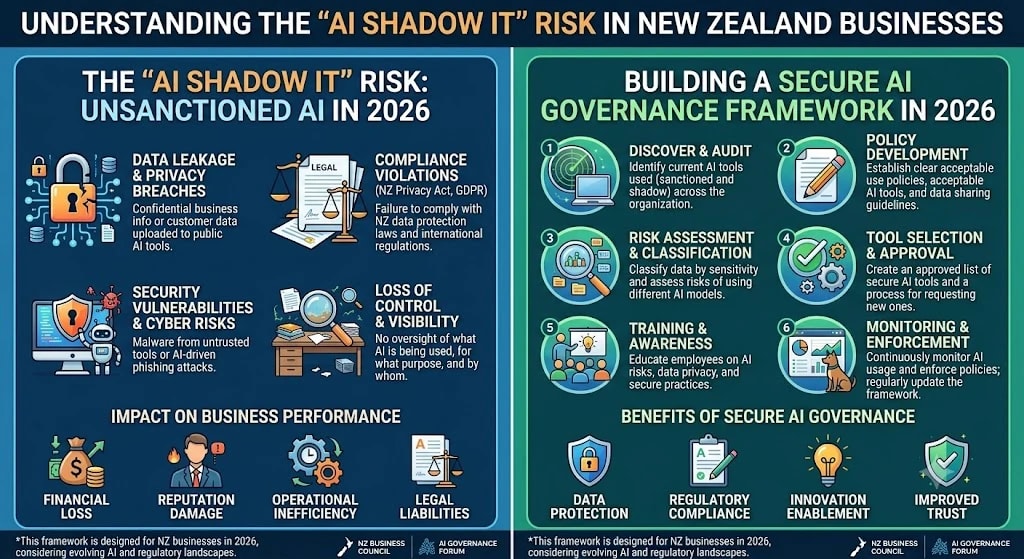
Discover the 'AI Shadow IT' risk in New Zealand businesses and learn how to build a secure AI governance framework for 2026 to protect sensitive data.
In 2026, is your business truly in control of its data? As AI rapidly integrates into daily workflows, a silent but significant threat is emerging within New Zealand enterprises: AI Shadow IT risk 2026. This isn't just about employees using unapproved software; it's about the uncontrolled proliferation of AI tools, from sophisticated language models to advanced image generators, handling sensitive company data without IT oversight.
Kiwi businesses, particularly those in bustling tech hubs like Wellington and Auckland, are known for their agility and eagerness to adopt innovative technologies. New Zealand boasts a thriving startup ecosystem and a rapidly growing digital economy, with businesses increasingly turning to custom software to compete globally. While this drive for innovation is commendable, it often leads employees to seek out the quickest, most accessible solutions – and in 2026, those solutions are often free or low-cost AI tools.
However, the convenience of these unsanctioned AI applications comes at a steep price. Your business faces significant risks including data breaches, compliance violations under the New Zealand Privacy Act 2020, inconsistent operational outputs, and a complete lack of control over intellectual property. Ignoring this burgeoning problem could cost your business millions in fines, reputational damage, and lost competitive advantage.
In this guide, we cover the definition and dangers of AI Shadow IT, and provide a practical, step-by-step framework for building a robust AI governance framework designed specifically for the New Zealand business landscape in 2026.
Table of Contents
- What are AI & ML Solutions?
- Why New Zealand Businesses Need a Secure AI Governance Framework in 2026
- The Dangers of AI Shadow IT: What's at Stake for Your Business
- Key Factors Affecting AI Governance Framework Scope & Timeline
- Developing Your AI Governance Framework: A Step-by-Step Guide
- Pricing for AI & ML Governance Consulting in New Zealand (2026)
- Benefits & ROI of Robust AI Governance for New Zealand Businesses
- Common Mistakes to Avoid in AI Governance
- How to Choose the Right AI & ML Solutions Partner for Governance in New Zealand
- FAQ Section
- Why Choose Futurise Solutions?
What are AI & ML Solutions?
Artificial Intelligence (AI) and Machine Learning (ML) solutions encompass a broad spectrum of technologies designed to enable machines to perform tasks that typically require human intelligence. These solutions allow systems to learn from data, identify patterns, make decisions, and even understand and generate human-like content.
Defining AI Solutions
AI solutions refer to the overarching field, including everything from basic automation to complex cognitive systems. They aim to replicate human intelligence, problem-solving, and decision-making capabilities.
- Rule-Based Systems: Early forms of AI that follow predefined rules.
- Expert Systems: AI designed to mimic the decision-making ability of a human expert.
- Advanced AI: Modern AI, often powered by ML, capable of learning and adapting.
Understanding ML Solutions
Machine Learning is a subset of AI that focuses on building systems that can learn from data without explicit programming. Instead of being programmed with specific instructions, ML algorithms use data to build a model that can make predictions or decisions.
- Supervised Learning: Algorithms learn from labeled data to predict outcomes (e.g., predicting customer churn).
- Unsupervised Learning: Algorithms find patterns in unlabeled data (e.g., customer segmentation).
- Reinforcement Learning: Algorithms learn through trial and error, optimizing actions to achieve a goal (e.g., autonomous systems).
Common AI & ML Applications in Business
The applications are vast and transformative, impacting nearly every industry. From enhancing customer service to optimising supply chains, AI and ML are driving efficiency and innovation.
- Customer Service Automation: Think AI chatbots that handle common queries or intelligent assistants. Futurise Solutions offers specialised AI & ML Solutions to develop custom agents.
- Data Analysis & Prediction: Identifying trends, forecasting sales, and predicting equipment failures.
- Personalisation: Tailoring product recommendations or content experiences for individual users.
- Process Automation: Automating repetitive tasks, improving operational efficiency.
- Content Generation: Creating marketing copy, reports, or even code snippets.
Why New Zealand Businesses Need a Secure AI Governance Framework in 2026
The rapid acceleration of AI adoption means that by 2026, virtually every New Zealand business, regardless of size, will be leveraging AI in some capacity. While the benefits are clear, the unmanaged integration of AI tools presents significant risks that demand a proactive AI governance framework.
The Pervasive Nature of AI in 2026
AI is no longer a niche technology; it's embedded in everyday applications, from productivity suites to marketing platforms. Employees are naturally gravitating towards these accessible tools to enhance their work, often without understanding the underlying security implications.
- Ease of Access: Many powerful AI tools are freely available online or integrated into common software.
- Productivity Boost: Employees use AI to draft emails, summarise documents, generate code, and create content faster.
- Lack of Awareness: Most users are unaware of the data privacy, security, and compliance risks associated with inputting sensitive company information into public AI models.
Navigating the New Zealand Regulatory Landscape
New Zealand's regulatory environment, particularly the New Zealand Privacy Act 2020, places strict obligations on businesses regarding the collection, storage, and use of personal information. Unsanctioned AI tools can easily lead to non-compliance.
- Data Privacy Obligations: Businesses are responsible for protecting personal data, even when processed by third-party AI tools.
- Consent Requirements: Using customer data with AI may require specific consent, which is often overlooked with informal tool usage.
- Breach Notification: In the event of a data breach involving AI Shadow IT, your business is legally obligated to report it, incurring reputational damage and potential fines.
Protecting Intellectual Property and Competitive Advantage
The unsupervised use of AI tools poses a direct threat to your business's intellectual property and competitive edge. Proprietary data, trade secrets, and unique business strategies can inadvertently be exposed.
- Data Leakage: Inputting confidential client lists, strategic plans, or proprietary code into public AI models can make that data accessible to the AI provider or even other users.
- Loss of IP: If an AI model "learns" from your proprietary data without proper agreements, your unique insights could become diluted or replicated.
- Inconsistent Outputs: Different employees using various AI tools can lead to varied brand messaging, inconsistent data analysis, and non-standardised processes, hindering overall business performance.
The Dangers of AI Shadow IT: What's at Stake for Your Business
AI Shadow IT risk 2026 is not merely a hypothetical concern; it's a tangible threat with serious financial, legal, and reputational consequences for businesses across New Zealand. Understanding these dangers is the first step towards building a robust secure AI implementation strategy.
Data Security Breaches and Confidentiality Risks
The most immediate and critical danger of unsanctioned AI tools is the potential for devastating data security breaches. When employees input sensitive information into public or unvetted AI services, your company's data is no longer under your control.
- Exposure of Sensitive Data: This includes customer details, financial records, confidential project plans, trade secrets, and employee information. Once data is fed into a third-party AI model, it can be stored, processed, and potentially used to train that model, making it incredibly difficult to retrieve or ensure its privacy.
- Lack of Encryption and Security Controls: Many free or low-cost AI tools lack enterprise-grade security features, encryption protocols, and access controls that your IT department would typically enforce. This creates glaring vulnerabilities for cyberattacks.
- Compliance Violations: Breaching data confidentiality through AI Shadow IT can lead to severe penalties under the New Zealand Privacy Act 2020, including fines up to NZ$10,000 for individuals and NZ$1,000,000 for organisations.
Compliance and Regulatory Penalties
Beyond the New Zealand Privacy Act, businesses operate under various industry-specific regulations and international data standards. AI Shadow IT can inadvertently lead to widespread non-compliance.
- GDPR (for international operations): If your New Zealand business interacts with European customers, GDPR compliance is critical. Uncontrolled AI usage can easily violate data processing principles.
- Industry-Specific Regulations: Financial services, healthcare, and government sectors have even stricter data handling requirements. Shadow AI tools can bypass these, leading to significant legal repercussions.
- Auditing Challenges: Without a clear record of AI tool usage and data flows, your business will struggle to demonstrate compliance during audits, increasing legal exposure.
Inconsistent Operations and Brand Dilution
The lack of centralized AI management fosters a fragmented approach to operations, leading to inefficiencies and undermining your brand identity.
- Varied Outputs and Quality: Different AI tools produce different results. One employee might use an AI to generate marketing copy that aligns with brand guidelines, while another uses a different tool that produces off-brand content, leading to inconsistent messaging and a diluted brand voice.
- Inefficient Workflows: Without a standardised suite of approved AI tools, teams may duplicate efforts, struggle with interoperability, and waste time vetting individual tools.
- Loss of Data Integrity: If critical business decisions are being made based on data processed by unverified AI tools, the integrity and reliability of that data are compromised, potentially leading to poor strategic outcomes.
Reputational Damage and Loss of Trust
A data breach or compliance violation stemming from AI Shadow IT can severely damage your business's reputation, eroding customer and stakeholder trust.
- Public Scrutiny: News of data breaches travels fast, especially in a connected market like New Zealand. This can lead to negative media coverage and public outcry.
- Customer Exodus: Customers are increasingly savvy about data privacy. A perceived lapse in security can cause them to take their business elsewhere.
- Investor Confidence: Investors and partners will view uncontrolled AI usage as a significant risk, potentially impacting funding, partnerships, and market valuation.
Key Factors Affecting AI Governance Framework Scope & Timeline
Developing an AI governance framework isn't a one-size-fits-all project. Its scope, complexity, and timeline depend heavily on several crucial factors unique to your New Zealand business. Understanding these will help you set realistic expectations and allocate resources effectively for secure AI implementation.
Existing IT Infrastructure and Security Posture
The maturity of your current IT systems and security protocols significantly impacts the effort required to integrate AI governance. Businesses with robust existing frameworks will have an easier time.
- Legacy Systems: Older systems may not easily integrate with modern AI governance tools, requiring more custom development or phased implementation.
- Data Security Maturity: If your business already has strong data encryption, access controls, and incident response plans, extending these to AI tools is simpler.
- Cloud Adoption: Businesses heavily reliant on cloud services may find it easier to implement cloud-native AI governance solutions, but also need to consider cloud-specific AI risks.
Size and Complexity of Your Organisation
Larger, more complex organisations naturally require a more comprehensive and intricate governance framework than smaller businesses.
- Number of Employees: More employees mean a higher potential for AI Shadow IT and a greater need for widespread training and monitoring.
- Departmental Silos: Diverse departments using different AI tools for varied purposes will require a more nuanced policy that addresses specific use cases while maintaining overarching control.
- Geographical Distribution: Businesses with multiple offices, especially across New Zealand (e.g., Auckland, Christchurch, Wellington) or internationally, need to consider consistent policy application and data sovereignty.
Industry and Regulatory Requirements
The sector your business operates in dictates the level of regulatory scrutiny and the specific compliance standards your AI governance framework must meet.
- Highly Regulated Industries: Finance, healthcare, and government sectors face stringent data privacy and ethical AI requirements, demanding a more rigorous and auditable framework.
- Sensitive Data Handling: If your business processes large volumes of personal, financial, or health information, your governance must prioritise data protection and ethical use above all else, often referencing the New Zealand Privacy Act 2020.
- International Operations: Businesses dealing with international clients will need to consider global regulations like GDPR, adding layers of complexity to their AI compliance 2026 strategy.
Existing AI Adoption Level and Future Ambitions
The current state of AI usage within your company and your strategic goals for AI integration will shape the governance framework.
- Current AI Tool Proliferation: If AI Shadow IT is already rampant, the initial phase will involve significant discovery and remediation efforts.
- Strategic AI Initiatives: If your business plans to implement custom AI solutions, such as developing a bespoke AI support agent or integrating LLM + RAG systems (which Futurise Solutions specialises in), your governance framework must accommodate these planned deployments from the outset. You can see examples of our work in our Portfolio.
- Innovation vs. Control: Finding the right balance between fostering innovation and maintaining strict control is crucial. A governance framework should not stifle experimentation but guide it safely.
Developing Your AI Governance Framework: A Step-by-Step Guide
Building a robust AI governance framework is an essential strategic initiative for any New Zealand business aiming for secure AI implementation in 2026. This isn't just about restricting tools; it's about enabling innovation safely and responsibly.
1. Establish a Cross-Functional AI Governance Committee
Successful governance starts with dedicated leadership and diverse perspectives. This committee will champion the framework and ensure its adoption.
- Identify Key Stakeholders: Include representatives from IT, Legal, HR, Data Privacy, and relevant business units (e.g., Marketing, Product Development). For businesses in Auckland or Christchurch, ensure regional representation if applicable.
- Define Roles and Responsibilities: Clearly outline who is accountable for policy creation, tool vetting, incident response, and ongoing monitoring.
- Set the Mission and Vision: Articulate the committee's purpose – to enable safe, compliant, and ethical AI use that supports business objectives without stifling innovation.
2. Conduct a Comprehensive AI Tool Audit and Risk Assessment
You can't govern what you don't know. The first practical step is to understand the current landscape of AI tool usage within your organisation.
- Discover Existing AI Tools: Employ technical scanning tools, employee surveys, and departmental interviews to identify all AI applications currently in use, both sanctioned and unsanctioned. This includes free online tools, browser extensions, and integrated features within existing software.
- Assess Data Input and Usage: For each identified tool, determine what type of data (personal, confidential, proprietary) is being input, how it's processed, where it's stored, and by whom.
- Evaluate Security and Compliance Risks: Rate each tool based on its potential for data breaches, compliance violations (especially concerning the New Zealand Privacy Act 2020), and operational inconsistencies. Prioritise risks for remediation.
3. Develop Clear AI Usage Policies and Guidelines
Policies provide the guardrails for responsible AI use. They must be clear, concise, and easily accessible to all employees.
- Acceptable Use Policy for AI: Define what types of AI tools are permitted, for what purposes, and with what types of data. Prohibit the input of confidential or personal data into unapproved public AI models.
- Data Handling Guidelines for AI: Specify how data should be prepared, anonymised, or de-identified before being used with approved AI tools. Emphasise the importance of data sovereignty and where data is processed.
- Intellectual Property and Copyright: Provide guidance on the ownership of AI-generated content and the proper attribution of sources, especially when using generative AI for creative tasks.
- Ethical AI Principles: Outline your company's stance on bias, fairness, transparency, and accountability in AI use.
4. Implement a Formal AI Tool Vetting and Approval Process
This process ensures that any new AI tool introduced into your business meets your security, compliance, and operational standards.
- Centralised Request System: Establish a clear process for employees or departments to request approval for new AI tools.
- Technical and Legal Review: Require IT security to assess the tool's security features, data handling practices, and integration capabilities. Legal and privacy teams must review vendor contracts for data processing agreements, compliance with the New Zealand Privacy Act 2020, and intellectual property clauses.
- Risk-Based Approval Tiers: Categorise tools based on their risk profile. Low-risk tools (e.g., grammar checkers) might have a fast-track approval, while high-risk tools (e.g., those handling sensitive customer data) require rigorous scrutiny. For complex custom AI developments, such as an AI Support Agent Case Study, Futurise Solutions follows a rigorous development and vetting process.
5. Provide Comprehensive Employee Training and Awareness
Policies are only effective if employees understand and adhere to them. Continuous education is vital for managing unsanctioned AI tools.
- Mandatory Training Modules: Develop engaging training on AI Shadow IT risks, company AI policies, and the proper use of approved tools. Include real-world examples of potential harm.
- Regular Refreshers: Conduct periodic training sessions and disseminate updates on new policies or emerging AI risks.
- Communication Channels: Create accessible channels for employees to ask questions about AI tools and report potential policy violations or security concerns.
6. Implement Monitoring and Enforcement Mechanisms
Ongoing monitoring is crucial to ensure adherence to the governance framework and to detect new instances of AI Shadow IT.
- Network and Endpoint Monitoring: Utilise security tools to detect unapproved software installations or unusual data flows to known AI service providers.
- Data Loss Prevention (DLP): Implement DLP solutions to prevent sensitive data from being copied or uploaded to unapproved external AI platforms.
- Regular Audits: Conduct periodic internal audits of AI tool usage and data practices to ensure compliance.
- Enforcement Actions: Clearly define the consequences for policy violations, ranging from retraining to disciplinary action, to reinforce the importance of the framework.
Pricing for AI & ML Governance Consulting in New Zealand (2026)
Investing in a robust AI governance framework is an investment in your business's future security, compliance, and sustained innovation. The costs for developing and implementing such a framework in New Zealand in 2026 can vary significantly based on the complexity of your organisation, the depth of the audit required, and the scope of the policies and systems to be put in place. Futurise Solutions offers tailored AI risk management services to meet these diverse needs.
When considering pricing, it's helpful to distinguish between custom AI/ML solution development and the consulting services required to establish a strong governance framework. While the table below outlines typical costs for custom AI solutions, governance consulting focuses on policy, process, and strategic oversight.
| Solution Type | Estimated Cost (NZD) | USD Equivalent |
|---|---|---|
| AI Chatbot / Assistant | NZ$5,000–NZ$15,000 | $3,000–$9,000 |
| Custom AI Agent (Single workflow) | NZ$10,000–NZ$30,000 | $6,000–$18,000 |
| LLM Integration + RAG System | NZ$15,000–NZ$50,000 | $9,000–$30,000 |
| NLP / Computer Vision Solution | NZ$25,000–NZ$90,000 | $15,000–$54,000 |
| Enterprise AI Platform | NZ$80,000–NZ$300,000+ | $48,000–$180,000+ |
Governance Consulting & Implementation Costs
For a comprehensive AI governance engagement, including risk assessment, policy development, tool vetting process creation, and initial training materials, New Zealand businesses can expect the following ranges in 2026:
- Small to Medium Business (SMB) Governance (NZ$15,000 – NZ$40,000):
- Scope: Initial AI Shadow IT audit, development of core AI usage policies, basic tool vetting process, and introductory employee training materials. Focused on immediate risks and compliance with New Zealand Privacy Act 2020.
- Timeline: 4-8 weeks.
- Mid-Market Enterprise Governance (NZ$40,000 – NZ$120,000):
- Scope: In-depth AI Shadow IT audit across multiple departments, development of comprehensive AI governance policies (including ethical AI, data handling, IP), formal tool vetting and approval workflow, detailed risk assessment, and tailored training programs. May include recommendations for centralized AI management tools.
- Timeline: 8-16 weeks.
- Large Enterprise / Complex Governance (NZ$120,000 – NZ$300,000+):
- Scope: Extensive enterprise-wide audit, development of a multi-layered AI governance framework, integration with existing GRC (Governance, Risk, and Compliance) systems, advanced AI risk management strategies, continuous monitoring recommendations, and ongoing advisory support. This often involves developing custom dashboards or integrations.
- Timeline: 16-30+ weeks.
These figures are estimates and can fluctuate based on the specific requirements, the number of stakeholders involved, and the level of customisation needed. Futurise Solutions provides transparent, fixed-price or time-and-materials quotes after a thorough discovery phase.
Typical Process & Timeline for AI Governance Implementation
Implementing an AI governance framework is a structured project that requires careful planning and execution. Futurise Solutions follows a proven methodology to ensure a smooth and effective deployment for New Zealand businesses.
| Phase | Description | Key Activities | Estimated Timeline |
|---|---|---|---|
| 1. Discovery & Assessment | Understand current AI usage, identify risks, and define project scope. | Initial consultations, AI Shadow IT audit, stakeholder interviews, risk assessment (security, compliance, data privacy). | 2-4 Weeks |
| 2. Strategy & Policy Development | Design the core governance framework and draft policies. | AI Governance Committee formation, policy drafting (acceptable use, data handling, IP, ethics), tool vetting process design, compliance mapping (e.g., New Zealand Privacy Act 2020). | 4-8 Weeks |
| 3. Implementation & Integration | Roll out policies, tools, and training. | Deployment of approved AI tools, integration with existing IT security/DLP, development of training materials, pilot training programs. | 6-12 Weeks |
| 4. Training & Rollout | Educate all employees and formally launch the framework. | Company-wide mandatory training, communication campaigns, creation of support channels, formal framework launch. | 2-4 Weeks |
| 5. Monitoring & Optimisation | Continuous oversight, enforcement, and refinement. | Ongoing network/endpoint monitoring, regular compliance audits, feedback collection, policy updates, incident response planning. | Ongoing |
This typical timeline can vary based on the size and complexity of your organisation, as well as the initial state of your AI adoption and existing IT infrastructure. For businesses looking to develop custom AI applications alongside governance, our AI & ML Solutions also follow a structured development process.
Benefits & ROI of Robust AI Governance for New Zealand Businesses
Implementing a robust AI governance framework is not merely a cost center or a compliance burden; it's a strategic investment that delivers tangible benefits and a significant return on investment (ROI) for New Zealand businesses in 2026. Beyond mitigating AI Shadow IT risk 2026, it enables safer innovation and stronger competitive advantage.
Enhanced Data Security and Reduced Breach Risk
The primary benefit is the dramatic reduction in the likelihood and impact of data breaches caused by unsanctioned AI tools. Protecting your data is paramount.
- Proactive Risk Mitigation: By identifying and controlling AI Shadow IT, you eliminate unknown vulnerabilities where sensitive data could be exposed.
- Stronger Data Protection: Approved AI tools operate within your established security protocols, including encryption, access controls, and data residency requirements.
- Cost Savings from Avoided Breaches: A single data breach can cost millions in fines, legal fees, investigative costs, and reputational damage. Preventing even one breach provides substantial ROI.
Guaranteed Regulatory Compliance and Legal Protection
A well-defined governance framework ensures your business operates within legal boundaries, safeguarding against costly penalties and legal challenges.
- Adherence to New Zealand Privacy Act 2020: Your framework explicitly addresses the requirements for data collection, storage, and processing when using AI, ensuring compliance.
- Reduced Fines and Legal Exposure: By demonstrating due diligence and a commitment to responsible AI, your business minimises its risk of regulatory fines and lawsuits.
- Easier Audits: With clear policies, documented processes, and a centralised record of approved tools, demonstrating AI compliance 2026 during audits becomes significantly smoother.
Improved Operational Efficiency and Consistency
Beyond security, governance streamlines AI adoption, making it a powerful tool for productivity rather than a source of chaos.
- Standardised AI Workflows: Employees use approved, vetted tools and follow consistent guidelines, leading to uniform outputs and reliable data processing. This avoids the inefficiencies of disparate tools producing varied results.
- Optimised Resource Allocation: IT and development teams can focus on strategic AI initiatives and support rather than constantly chasing down unsanctioned tools.
- Enhanced Data Integrity: By controlling the input and processing of data through AI, your business maintains higher data quality, leading to more accurate insights and better decision-making.
Fostering Responsible Innovation and Competitive Advantage
A secure framework doesn't stifle innovation; it enables it by providing a safe sandbox for experimentation and strategic AI adoption.
- Safe AI Experimentation: Employees can explore new AI capabilities within approved environments, fostering a culture of innovation without compromising security.
- Strategic AI Adoption: Your business can strategically invest in and deploy powerful custom AI solutions, like those developed by Futurise Solutions, knowing they are secure and compliant. Our AI Support Agent Case Study demonstrates how controlled AI can deliver significant operational improvements.
- Stronger Reputation and Trust: Demonstrating a commitment to ethical and secure AI builds trust with customers, partners, and employees, enhancing your brand reputation in a digitally conscious market. This is crucial for businesses in competitive environments like Auckland and Wellington.
Common Mistakes to Avoid in AI Governance
While the benefits of an AI governance framework are clear, many New Zealand businesses fall into common traps during implementation. Avoiding these pitfalls is crucial for successful secure AI implementation and effective managing unsanctioned AI tools.
1. Underestimating the Scope of AI Shadow IT
The hidden nature of AI Shadow IT often leads businesses to underestimate its prevalence and impact.
- Ignoring the "Small" Tools: It's easy to focus on large, obvious AI platforms, but many employees use browser extensions, productivity apps with integrated AI, or free online tools for quick tasks. These seemingly innocuous tools can still pose significant data risks.
- Assuming Employees Know Better: Many employees are simply unaware of the risks associated with entering company data into public AI models. Education is key, not just prohibition.
- Lack of Comprehensive Discovery: Relying solely on employee self-reporting will miss much of the Shadow IT. Technical scanning and proactive discovery are essential.
2. Creating Overly Restrictive Policies
While control is necessary, overly rigid or impractical policies can backfire, driving AI usage further underground.
- Stifling Innovation: If the approval process for new AI tools is too slow or complex, employees will bypass it, defeating the purpose of governance.
- One-Size-Fits-All Approach: Different departments have different AI needs and risk profiles. A blanket ban or overly generic policy won't work for a diverse workforce, especially in a dynamic market like New Zealand's digital economy.
- Lack of Flexibility: The AI landscape evolves rapidly. Policies must be designed to be adaptable and regularly reviewed, rather than set in stone.
3. Neglecting Employee Training and Communication
A governance framework is only as strong as its weakest link – often, an uninformed employee.
- "Set It and Forget It" Mentality: A one-time training session is insufficient. Ongoing education, clear communication channels, and regular refreshers are vital.
- Technical Jargon Overload: Policies and training materials must be clear, jargon-free, and relevant to employees' daily work. Focus on why policies are in place, not just what they are.
- Lack of Buy-in: Without explaining the benefits to employees (e.g., protecting their jobs, company reputation, and personal data), they may view governance as an impediment rather than a safeguard.
4. Failing to Implement Continuous Monitoring and Adaptation
The AI landscape is dynamic; a static governance framework will quickly become obsolete.
- One-Off Audits: AI Shadow IT is an ongoing battle. Continuous monitoring using network, endpoint, and data loss prevention (DLP) tools is essential to detect new threats.
- Ignoring Feedback: User feedback on approved tools and policies can highlight pain points and areas for improvement. Ignoring this feedback can lead to frustration and non-compliance.
- Not Evolving with Technology: New AI capabilities and risks emerge constantly. Your AI risk management strategy and policies must be reviewed and updated regularly to remain effective in 2026 and beyond.
5. Overlooking Legal and Ethical Considerations
Compliance isn't just about security; it's also about ethics and legal obligations.
- Ignoring Data Sovereignty: For New Zealand businesses, understanding where data is processed and stored by AI tools is critical, especially when dealing with public cloud AI services that may store data offshore.
- Neglecting Bias and Fairness: AI models can perpetuate or even amplify existing biases. Your governance framework must address ethical AI principles, particularly when AI is used for critical decision-making processes.
- Insufficient Legal Review: Ensure all vendor contracts for approved AI tools include robust data processing agreements, compliance clauses (e.g., New Zealand Privacy Act 2020), and clear intellectual property rights.
How to Choose the Right AI & ML Solutions Partner for Governance in New Zealand
Selecting the right partner to help your New Zealand business navigate the complexities of AI governance framework development and secure AI implementation is a critical decision. You need a partner who understands both the technical intricacies of AI and the specific business and regulatory landscape of New Zealand.
1. Proven Expertise in AI & ML Solutions
Look for a partner with a deep understanding of the AI and ML ecosystem, not just general IT security.
- Demonstrated AI Project Experience: The partner should have a track record of developing and deploying various AI & ML Solutions, from custom AI agents to enterprise AI platforms. This shows they understand the technology they are helping you govern. Review their Portfolio and Case Studies.
- Understanding of AI Risks: They must be intimately familiar with the specific security, privacy, and ethical risks inherent in different AI models and applications.
- Knowledge of Emerging AI Trends: The AI landscape is constantly evolving. A good partner stays ahead of new technologies and potential threats, ensuring your framework is future-proof for 2026 and beyond.
2. Strong Focus on Security and Compliance
Given the core problem of AI Shadow IT risk 2026, the partner's security and compliance credentials are non-negotiable.
- Cybersecurity Expertise: They should have robust cybersecurity practices themselves and a proven ability to assess and mitigate security vulnerabilities within AI systems.
- Regulatory Compliance Knowledge: Crucially, they must understand the New Zealand Privacy Act 2020 and other relevant local and international data protection regulations. This ensures your governance framework is legally sound.
- Data Privacy Best Practices: The partner should advocate for and implement data privacy by design principles in all AI initiatives.
3. Local Market Understanding and Global Perspective
A partner who understands the unique nuances of the New Zealand market combined with a global outlook offers the best of both worlds.
- New Zealand Business Context: They should understand the challenges and opportunities for Kiwi businesses, whether you're in Wellington, Auckland, or Christchurch. This includes appreciating the local digital economy (NZ$4.2B market size) and the drive for innovation.
- Client References in New Zealand: Ask for testimonials or case studies from other New Zealand businesses they've helped with AI or digital transformation projects.
- Global Best Practices: While local context is vital, they should also bring insights from international AI governance best practices, ensuring your framework is world-class.
4. A Comprehensive, End-to-End Approach
Look for a partner who can support you through the entire journey, from initial assessment to ongoing optimisation.
- Discovery and Strategy: They should offer thorough AI Shadow IT audits, risk assessments, and strategic planning for your governance framework.
- Policy Development and Implementation: The partner should assist in drafting clear policies, establishing vetting processes, and integrating governance into your existing IT infrastructure.
- Training and Support: They should provide resources and expertise for employee training, fostering a culture of responsible AI use.
- Ongoing Monitoring and Advisory: The ideal partner offers continued support, helping you adapt your framework as AI technologies evolve and new risks emerge, ensuring effective AI risk management.
5. Transparent Communication and Collaborative Partnership
A successful governance project relies on open and honest communication.
- Clear Communication Channels: The partner should establish transparent communication, providing regular updates and being responsive to your questions.
- Collaborative Approach: They should work with your internal teams, transferring knowledge and building internal capabilities rather than just delivering a black-box solution.
- Transparent Pricing: Expect clear breakdowns of costs for different phases of the project, as discussed in the "Pricing in New Zealand (2026)" section.
Futurise Solutions, a full-cycle digital product studio based in Wellington, New Zealand, embodies these qualities. We specialise in AI & ML Solutions and have a deep understanding of the New Zealand market, coupled with global expertise in secure AI implementation and governance. Read more About Futurise Solutions and how we can assist your business.
FAQ Section
Q1: What is AI Shadow IT?
A1: AI Shadow IT refers to the use of artificial intelligence tools and services by employees within an organisation without the knowledge, approval, or oversight of the IT department. This includes free online AI services, browser extensions, or integrated AI features in unvetted software.
Q2: Why is AI Shadow IT a significant risk for New Zealand businesses in 2026?
A2: In 2026, AI Shadow IT is a critical concern due to the widespread availability of powerful AI tools. It poses significant risks like data breaches, non-compliance with the New Zealand Privacy Act 2020, exposure of intellectual property, inconsistent business operations, and reputational damage.
Q3: What is an AI governance framework?
A3: An AI governance framework is a structured system of policies, processes, roles, and responsibilities designed to manage and control the ethical, secure, and compliant development and deployment of AI solutions within an organisation. It aims to balance innovation with risk mitigation.
Q4: How does an AI governance framework help with compliance?
A4: A robust AI governance framework ensures your business adheres to relevant data privacy laws, such as the New Zealand Privacy Act 2020, and industry-specific regulations. It establishes guidelines for data handling, consent, and transparency, significantly reducing the risk of compliance violations and associated penalties.
Q5: Can an AI governance framework stifle innovation?
A5: Properly designed, an AI governance framework should enable, not stifle, innovation. By providing clear guidelines, approved tools, and a safe process for vetting new technologies, it creates a secure environment for experimentation and strategic AI adoption, preventing uncontrolled risks that could force a complete halt to AI initiatives.
Q6: What's the first step for a New Zealand business to address AI Shadow IT?
A6: The first crucial step is to conduct a comprehensive AI tool audit and risk assessment. This involves identifying