The 'AI-Powered Micro-Moment Marketing' Playbook for 2026: Capturing Intent in a Fragmented World
Digital Marketing · By Futurise Solutions ·
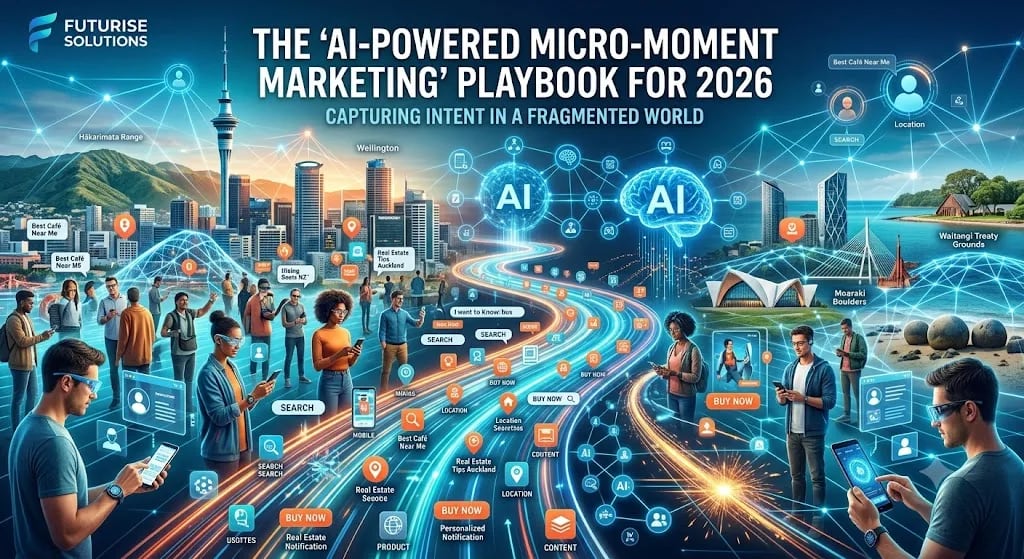
Is your New Zealand business struggling to hold customer attention in 2026? This playbook reveals how AI-powered micro-moment marketing captures intent in a fragmented world.
Is your New Zealand business struggling to hold customer attention amidst the digital noise of 2026? In an era where attention spans are measured in seconds and customer journeys are more fragmented than ever, traditional marketing funnels feel increasingly obsolete. From the bustling streets of Auckland to the innovative hubs of Wellington, Kiwi businesses are grappling with how to genuinely connect with their audience when intent is fleeting and touchpoints are multiplying.
The problem isn't a lack of data; it's an overload. It's the challenge of sifting through vast information to pinpoint the exact moment a customer needs something, wants to know something, or is ready to buy. This hyper-fragmented digital landscape demands a new approach, one that moves beyond broad strokes to microscopic precision. New Zealand has a thriving startup ecosystem and a rapidly growing digital economy, with businesses increasingly turning to custom software to compete globally. This means the stakes for effective, cutting-edge marketing are higher than ever.
Enter AI micro-moment marketing 2026 – the strategic framework designed to leverage artificial intelligence to identify, predict, and act on these fleeting customer intents. This isn't just about personalization; it's about anticipating needs and delivering hyper-relevant experiences in real-time. It's about ensuring your brand is present, helpful, and compelling precisely when it matters most, transforming those brief moments into meaningful micro-conversions.
In this guide, we cover what AI-powered micro-moment marketing entails, why it's crucial for your New Zealand business in 2026, how AI can predict and identify these critical moments, and a step-by-step playbook for implementation. We'll explore real-time content delivery, personalized offers, measuring micro-conversion success, and the essential tech stack you'll need.
Table of Contents
- What is Digital Marketing in 2026?
- Why New Zealand Businesses Need AI Micro-Moment Marketing in 2026
- Understanding Micro-Moments: The AI Era
- The AI-Powered Micro-Moment Marketing Playbook: Your Strategic Framework
- Phase 1: Data Foundation & AI Readiness
- Phase 2: Predictive Micro-Moment Identification
- Phase 3: Real-Time Personalization & Activation
- Phase 4: Measurement & Iteration
- Key Factors That Affect Cost, Scope & Timeline
- Pricing Digital Marketing in New Zealand (2026)
- Typical Process & Timeline for Implementing AI Micro-Moment Marketing
- Benefits & ROI for New Zealand Businesses
- Common Mistakes to Avoid in AI Micro-Moment Marketing
- How to Choose the Right Digital Marketing Partner in New Zealand
- FAQ Section
- Why Choose Futurise Solutions?
What is Digital Marketing in 2026?
Digital marketing in 2026 is far more sophisticated than simply having a website or running social media ads. It's an integrated ecosystem of strategies and technologies designed to connect with customers where they spend their time online, build brand awareness, drive engagement, and ultimately, convert leads into loyal customers. For New Zealand businesses, it's the lifeline to compete not just locally in Christchurch or Wellington, but on a global scale.
The Evolving Landscape of Digital Marketing
In 2026, digital marketing has evolved significantly, driven by advancements in artificial intelligence and machine learning. It's less about broadcasting messages and more about engaging in highly personalized, contextual conversations with individual customers. The focus has shifted from broad demographics to granular behavioral insights, enabling unprecedented levels of targeting and relevance.
Key Components of Digital Marketing in the AI Era
- Search Engine Optimisation (SEO) and AI Overviews: Beyond traditional keyword ranking, AI Overviews (Google's generative AI summaries) are reshaping search behavior. SEO now involves optimizing for direct answers, featured snippets, and ensuring your content is seen as authoritative and trustworthy by AI models.
- Content Marketing & AI-Driven Delivery: Creating valuable, relevant content remains crucial, but AI now dictates its delivery. AI algorithms personalize content recommendations, optimize distribution channels, and even assist in content generation and repurposing for different formats and audiences.
- Paid Advertising (PPC & Paid Social) with Predictive AI: Programmatic advertising is standard, but predictive micro-moments allow for highly targeted ad delivery. AI optimizes bidding strategies, audience segmentation, and creative variations in real-time, maximizing return on ad spend.
- Social Media Marketing & AI-Powered Engagement: AI analyzes social sentiment, identifies trending topics, and helps automate responses, ensuring timely and relevant interactions. It also plays a key role in identifying micro-influencers who can authentically connect with niche audiences.
- Email Marketing & Hyper-Personalization: AI personalizes email content, subject lines, send times, and even product recommendations based on individual user behavior and preferences, moving far beyond basic segmentation.
- Conversion Rate Optimisation (CRO) & A/B Testing with AI: AI-driven tools analyze user behavior on websites and apps, identifying friction points and suggesting improvements. They can run multivariate tests at scale, accelerating the optimization process.
- AI & ML Solutions for Customer Experience: Chatbots, virtual assistants, and personalized recommendation engines are powered by AI, providing instant support and tailored experiences across all digital touchpoints. This is where the integration of AI & ML Solutions becomes critical for a seamless user journey.
Why New Zealand Businesses Need AI Micro-Moment Marketing in 2026
For Kiwi businesses, embracing AI micro-moment marketing isn't just an advantage; it's a necessity to thrive in the competitive global and local markets of 2026. The digital economy in New Zealand is robust, valued at NZ$4.2 billion, and growing rapidly. To capture a significant share of this, businesses must be at the forefront of digital innovation.
Combatting the Attention Economy
- Fragmented Customer Journeys: Modern customers interact with brands across countless devices and platforms – from quick searches on a smartphone to browsing on a tablet, then purchasing on a desktop. AI micro-moment marketing allows your business to stitch these fragmented customer journeys together, understanding the intent behind each interaction.
- Reduced Attention Spans: In a world saturated with information, human attention is a scarce commodity. AI allows you to cut through the noise by delivering highly relevant messages precisely when a customer is most receptive, preventing your brand from being ignored.
Driving Efficiency and ROI
- Optimised Marketing Spend: Instead of broad campaigns, AI focuses your budget on delivering messages to the right person at the right time. This significantly reduces wasted ad spend and improves the overall ROI for your marketing efforts.
- Scalable Personalization: Manual personalization is labor-intensive and difficult to scale. AI automates the process, allowing even small to medium-sized Kiwi businesses to deliver personalized experiences to thousands or millions of customers without significant human intervention.
Meeting Evolving Customer Expectations
- Demand for Instant Gratification: Customers expect immediate answers, solutions, and gratification. AI-driven responses and real-time personalization AI meet these expectations, enhancing customer satisfaction and loyalty.
- Hyper-Relevant Experiences: Generic messaging alienates customers. AI enables you to deliver truly contextual, useful information, products, or services that resonate deeply with individual needs, fostering stronger connections.
Staying Ahead of the Competition
- Innovation for Growth: Many New Zealand businesses are early adopters of technology. By implementing AI micro-moment marketing, your business positions itself as an innovator, attracting tech-savvy customers and talent.
- Global Competitiveness: To compete with international players, especially in the fast-growing digital product space, local businesses need world-class marketing strategies. AI provides the edge needed to stand out. Futurise Solutions, for example, helps local businesses scale globally with robust Web Development Services and App Development Services alongside cutting-edge marketing.
Understanding Micro-Moments: The AI Era
Micro-moments are those critical instances when people turn to a device – often a smartphone – to act on a need. They are intent-rich moments that occur in real-time. In 2026, AI has supercharged our ability to not just react to these moments, but to anticipate them.
Defining the Four Core Micro-Moments
Google originally defined these moments, and they remain foundational, now amplified by AI:
- "I want to know" moments: When consumers are researching or exploring, not necessarily looking to buy. Example: Searching for "best hiking trails near Wellington" or "how to compost kitchen waste." AI identifies these informational needs and delivers relevant blog posts, guides, or video content.
- "I want to go" moments: When consumers are looking for a local business or destination. Example: Searching for "cafes open late in Christchurch" or "car mechanic near me." AI leverages location data and search history to provide hyper-local, timely recommendations and directions.
- "I want to do" moments: When consumers need help completing a task or learning something new. Example: Searching for "DIY raised garden bed plans" or "how to fix a leaky tap." AI delivers instructional content, tutorials, or connects them with relevant services or products.
- "I want to buy" moments: When consumers are ready to make a purchase and need help deciding what or where to buy. Example: Searching for "best noise-cancelling headphones reviews" or "buy organic coffee beans online NZ." AI presents personalized product recommendations, offers, or direct purchase options, streamlining the path to conversion.
The AI Advantage: Beyond Reaction to Prediction
Traditional micro-moment marketing was largely reactive. A user searches, and you respond. With predictive micro-moments, AI shifts this paradigm.
- Predictive Analytics: AI analyzes vast datasets – browsing history, purchase patterns, demographic information (while adhering to the New Zealand Privacy Act 2020), location data, even sentiment analysis from social interactions – to anticipate when a customer is likely to enter a micro-moment.
- Contextual Understanding: AI goes beyond keywords to understand the full context of a user's current situation. Are they at home, at work, commuting? What device are they using? What's the weather like? This contextual marketing AI allows for truly relevant interventions.
- Intent Capture: AI's ability to decipher subtle cues in user behavior – hesitation, repeated searches, specific click patterns – enables sophisticated AI intent capture. This means identifying nascent intent before it's explicitly stated. For instance, a user repeatedly viewing product pages without adding to a cart might trigger an AI-powered offer or relevant content suggestion.
- Real-time Decisioning: AI platforms can process information and make marketing decisions in milliseconds, ensuring that the right message is delivered at the exact right time, not minutes or hours later.
By understanding and leveraging AI to predict and act on these micro-moments, your New Zealand business can move from simply advertising to truly serving your customers' immediate needs, fostering loyalty and driving conversions.
The AI-Powered Micro-Moment Marketing Playbook: Your Strategic Framework
Implementing AI micro-moment marketing 2026 requires a structured approach. This playbook outlines four key phases, moving your business beyond traditional funnels to a dynamic, AI-driven strategy.
Phase 1: Data Foundation & AI Readiness
Before you can leverage AI, you need clean, integrated data. This phase is about preparing your ecosystem.
1.1 Unify Your Customer Data Platform (CDP)
- Challenge: Customer data often lives in silos (CRM, analytics, marketing automation, e-commerce, customer support).
- Solution: Implement or optimize a robust Customer Data Platform (CDP). This centralizes all customer data, creating a single, comprehensive view of each individual. It's the brain that feeds your AI. Futurise Solutions offers expert guidance in integrating and optimizing your data infrastructure, often a precursor to advanced Digital Marketing Services.
- Action: Audit existing data sources, define data governance protocols, and select a CDP that integrates seamlessly with your current tech stack. Ensure compliance with the New Zealand Privacy Act 2020 from the outset.
1.2 Implement Advanced Analytics & Tracking
- Challenge: Basic analytics only tell you what happened, not why or what's next.
- Solution: Deploy advanced analytics tools, including event-based tracking, session recording, and heatmaps. This provides granular data on user behavior across your website, app, and other digital properties.
- Action: Define key micro-conversion events (e.g., viewing a product, adding to cart, downloading a guide, spending X seconds on a page) and ensure comprehensive tracking is in place.
1.3 Assess & Integrate Your AI Tech Stack
- Challenge: Many businesses have disparate AI tools, or none at all.
- Solution: Identify and integrate AI agents and predictive analytics tools into your marketing automation and CRM systems. This could include AI-powered recommendation engines, sentiment analysis tools, and real-time bidding platforms.
- Action: Partner with experts like Futurise Solutions to assess your current MarTech stack and recommend appropriate AI & ML Solutions for predictive micro-moments and AI intent capture.
Phase 2: Predictive Micro-Moment Identification
This is where AI truly shines, moving beyond reactive marketing to proactive anticipation.
2.1 Develop Predictive Models for Intent
- Challenge: Identifying intent before it's explicitly stated is complex.
- Solution: Utilize machine learning algorithms to analyze historical data from your CDP. These models learn patterns associated with different micro-moments ("I want to know," "I want to go," "I want to do," "I want to buy").
- Action: Train AI models on your customer data to recognize indicators of specific intent types. For example, repeated visits to product comparison pages might signal an "I want to buy" moment is imminent.
2.2 Leverage Real-Time Contextual Signals
- Challenge: User context changes rapidly.
- Solution: Integrate real-time data streams such as location (if opted-in), device type, time of day, current weather, recent searches (from your site), and even sentiment from customer service interactions. This feeds your contextual marketing AI.
- Action: Configure your CDP and AI tools to ingest and process these real-time signals, enriching the predictive models with immediate context.
2.3 Segment Audiences by Predicted Micro-Moment
- Challenge: Delivering personalized content without clear segmentation.
- Solution: Use AI to dynamically segment your audience not just by demographics, but by their predicted current or imminent micro-moment.
- Action: Create dynamic audience segments in your marketing automation platform that update based on AI's real-time predictions of customer intent.
Phase 3: Real-Time Personalization & Activation
Once a micro-moment is identified or predicted, this phase focuses on delivering the perfect experience.
3.1 AI-Driven Content Delivery
- Challenge: Manually matching content to individual intent is impossible at scale.
- Solution: Implement AI-driven content delivery systems that automatically select and serve the most relevant content (blog posts, videos, product pages, FAQs, case studies) based on the identified micro-moment and user profile.
- Action: Tag your content library thoroughly and integrate it with your AI recommendation engine. Ensure your website and app are designed for dynamic content serving, often requiring robust Web Development Services or App Development Services.
3.2 Personalized Offers & Calls-to-Action (CTAs)
- Challenge: Generic offers often miss the mark.
- Solution: AI generates and presents hyper-personalized offers, discounts, product bundles, or unique CTAs tailored to the user's current intent and stage in the journey.
- Action: Develop a library of dynamic offer templates and integrate them with your AI to trigger based on specific micro-moments. For example, an "I want to buy" moment for a specific product might trigger a limited-time discount.
3.3 Omnichannel Activation
- Challenge: Delivering consistent experiences across all touchpoints.
- Solution: Ensure your AI-powered responses and personalized content are delivered seamlessly across all relevant channels: website, mobile app, email, social media, chatbots, and even in-store (if applicable).
- Action: Map out customer journeys across channels and configure your AI and MarTech stack to activate relevant content and offers consistently. This might involve an AI Support Agent Case Study to see how seamless support integrates into this strategy.
Phase 4: Measurement & Iteration
Continuous improvement is vital for long-term success.
4.1 Track Micro-Conversion Optimization
- Challenge: Focusing only on macro-conversions ignores critical early indicators of success.
- Solution: Define and meticulously track micro-conversion optimization metrics for each micro-moment. Examples include time spent on relevant content, clicks on personalized recommendations, email open rates for targeted messages, and engagement with chatbots.
- Action: Set up dashboards to monitor micro-conversions in real-time. This provides immediate feedback on the effectiveness of your AI interventions.
4.2 A/B Testing & Multivariate Optimization with AI
- Challenge: Manually running and analyzing complex tests is slow and resource-intensive.
- Solution: Use AI-powered optimization tools to conduct continuous A/B and multivariate testing on different content variations, offer types, CTAs, and delivery mechanisms.
- Action: Leverage AI to automatically identify winning variations and deploy them at scale, constantly refining your strategy. This allows for rapid learning and improvement.
4.3 Feedback Loops & Model Refinement
- Challenge: AI models need continuous data to improve accuracy.
- Solution: Establish feedback loops where the outcomes of AI interventions (e.g., successful conversions, ignored offers) feed back into the AI models.
- Action: Regularly review model performance, identify areas for improvement, and retrain your AI models with new data to enhance their predictive accuracy and effectiveness in capturing AI intent capture.
By systematically following this playbook, your New Zealand business can transform its digital marketing from reactive to predictive, building deeper connections and driving significant growth in 2026 and beyond.
Key Factors That Affect Cost, Scope & Timeline
The investment in digital marketing, particularly advanced AI-powered strategies, for your New Zealand business in 2026 can vary significantly. Several factors influence the cost, scope, and timeline of implementing an effective strategy.
1. Current Digital Maturity & Infrastructure
- Factor: Where is your business currently with its digital presence and internal systems?
- Impact: If you have a legacy website, fragmented data, or no existing CDP, the initial setup costs for integration and data unification will be higher. A business with a modern tech stack and clean data will have a shorter, less expensive ramp-up. Futurise Solutions often begins with a thorough audit of your existing Web Development Services or App Development Services to understand the foundation.
- Example: A startup with minimal digital assets will likely need more foundational work than an established enterprise with a robust CRM and marketing automation system.
2. Scope of Services & Channels
- Factor: Which digital marketing channels and AI capabilities do you want to integrate?
- Impact: A comprehensive strategy covering SEO, content, PPC, social, email, and advanced AI personalization across all channels will naturally cost more and take longer than focusing on a single channel.
- Example: Implementing AI micro-moment marketing for only your e-commerce website is less complex than an omnichannel strategy that includes a mobile app, email, and physical store interactions.
3. Data Volume & Complexity
- Factor: How much customer data do you have, and how complex is it?
- Impact: Businesses with vast amounts of diverse data (e.g., transactional, behavioral, demographic, third-party) require more sophisticated AI models and data processing capabilities, increasing costs for AI & ML Solutions and cloud infrastructure.
- Example: A large retail chain with millions of customer interactions will have higher data management and AI training costs than a niche B2B service provider.
4. Customisation vs. Off-the-Shelf Solutions
- Factor: Do you need highly customized AI models and integrations, or can you leverage existing platforms?
- Impact: Bespoke AI development and custom integrations for unique business processes will significantly increase costs and timelines compared to configuring off-the-shelf AI marketing tools.
- Example: A business requiring a unique predictive micro-moments model for a highly specialized industry will incur higher development costs than one using a standard AI recommendation engine.
5. Team Expertise & Internal Resources
- Factor: What internal expertise do you have in data science, AI, and digital marketing?
- Impact: If your internal team lacks the skills to manage AI tools or analyze complex data, you'll need to invest more in external agency support, training, or hiring, which impacts overall cost.
- Example: A business with a strong in-house data analytics team can absorb more of the implementation work, reducing agency fees.
6. Competitive Landscape & Market Aggressiveness
- Factor: How competitive is your industry in New Zealand, and how aggressive are your growth targets?
- Impact: In highly competitive sectors (e.g., FinTech, SaaS), a more aggressive and cutting-edge AI micro-moment marketing strategy will be required, often with higher ad spend and more sophisticated AI tools, leading to higher costs.
- Example: A SaaS company aiming for rapid global expansion will need a more substantial investment in AI-driven content delivery and real-time personalization AI than a local boutique aiming for steady regional growth.
7. Regulatory Compliance
- Factor: Adherence to data privacy regulations.
- Impact: Ensuring full compliance with the New Zealand Privacy Act 2020 when collecting and processing customer data for AI models adds a layer of complexity and requires careful planning and potentially specialized legal/data privacy consultation, impacting timelines and costs.
- Example: Implementing robust consent mechanisms and data anonymization techniques for AI training data adds development and compliance overhead.
Understanding these factors will help your New Zealand business scope your digital marketing project effectively and budget accordingly.
Pricing Digital Marketing in New Zealand (2026)
In 2026, the cost of digital marketing services in New Zealand reflects the increasing sophistication of AI-powered strategies, the demand for skilled professionals, and the competitive market. Pricing models typically include monthly retainers, project-based fees, or a combination. The following table provides a general guide for monthly retainers for various levels of service, specifically tailored for the New Zealand market in NZD, with a USD equivalent for global context (using 1 NZD ≈ 0.60 USD).
It's important to remember that these are averages. Highly specialized agencies, niche services, or intensive AI micro-moment marketing campaigns will fall at the higher end or require custom quotes.
| Service Package | Monthly Cost (NZD) | USD Equivalent |
|---|---|---|
| SEO Foundation (audit + on-page) | NZ$1,500–NZ$4,000/mo | $900–$2,400/mo |
| Content Marketing + SEO | NZ$3,000–NZ$8,000/mo | $1,800–$4,800/mo |
| PPC / Paid Social Management | NZ$2,000–NZ$6,000/mo + ad spend | $1,200–$3,600/mo |
| Full Growth Package (SEO+PPC+CRO) | NZ$6,000–NZ$18,000/mo | $3,600–$10,800/mo |
| Enterprise Digital Marketing | NZ$15,000–NZ$50,000+/mo | $9,000–$30,000+/mo |
Understanding the Packages:
- SEO Foundation (audit + on-page): This package typically covers initial technical SEO audits, keyword research, on-page optimization for your website, and basic local SEO (crucial for businesses in Auckland, Wellington, or Christchurch). It's a starting point for improving organic visibility, especially with the impact of AI Overviews.
- Content Marketing + SEO: This expands on the foundation by including content strategy, creation (blog posts, articles, landing page copy), distribution, and link building. It's vital for establishing authority and addressing "I want to know" micro-moments with AI-driven content delivery.
- PPC / Paid Social Management: Focuses on managing your paid advertising campaigns on platforms like Google Ads, Meta (Facebook/Instagram), LinkedIn, etc. The cost listed is for agency management fees; ad spend is additional and depends entirely on your budget. This is where predictive micro-moments for "I want to buy" moments can be highly effective.
- Full Growth Package (SEO+PPC+CRO): A comprehensive solution combining organic search, paid advertising, and micro-conversion optimization efforts. This package aims for holistic growth, leveraging AI for both traffic generation and conversion efficiency.
- Enterprise Digital Marketing: Tailored for larger organizations with complex needs, multiple brands, or global reach. This includes advanced AI micro-moment marketing strategies, dedicated account teams, custom AI & ML Solutions, sophisticated data analytics, and often includes elements of UI/UX Design Services for optimal user journeys.
What Influences Price Fluctuation within Packages:
- Industry Niche: Highly competitive or specialized industries often require more intensive strategies and therefore higher costs.
- Website Size & Complexity: Larger websites with extensive product catalogs or content libraries require more effort for SEO and content management.
- Target Market: Local campaigns (e.g., targeting only Wellington) might be less expensive than national or international campaigns.
- Reporting & Communication: The level of detailed reporting, frequent meetings, and strategic consultation can impact the monthly fee.
- AI Integration Depth: The more deeply you integrate and customize AI tools for real-time personalization AI and AI intent capture, the higher the investment.
When considering an agency, always request a detailed proposal that outlines the specific services, expected outcomes, and how your investment will contribute to your business goals.
Typical Process & Timeline for Implementing AI Micro-Moment Marketing
Implementing an AI micro-moment marketing strategy is a significant undertaking that requires careful planning and execution. While timelines can vary based on your business's existing infrastructure and the chosen scope, here's a typical process and estimated timeline for a New Zealand business partnering with a digital product studio like Futurise Solutions.
| Phase | Key Activities | Estimated Timeline |
|---|---|---|
| 1. Discovery & Strategy | Initial consultations, goal setting, audience analysis, competitive research, MarTech stack audit, AI readiness assessment, data privacy review (NZ Privacy Act 2020). | 2-4 Weeks |
| 2. Data Foundation & Integration | CDP implementation/optimization, data cleaning & migration, advanced analytics setup, API integrations (CRM, e-commerce, marketing automation), AI tools selection. | 6-12 Weeks |
| 3. AI Model Development & Training | Define micro-moment types, develop predictive models, train AI with historical data, establish real-time signal ingestion, content tagging. | 8-16 Weeks |
| 4. Content & Experience Design | Create dynamic content assets, design personalized offer templates, optimize UI/UX for dynamic delivery, develop omnichannel activation strategies. | 4-8 Weeks |
| 5. Implementation & Launch | Integrate AI into live marketing campaigns, deploy personalized website/app experiences, configure real-time activation, initial A/B testing setup. | 4-8 Weeks |
| 6. Monitoring, Optimisation & Scaling | Continuous performance monitoring, micro-conversion analysis, AI model refinement, iterative A/B testing, scaling successful strategies. | Ongoing (Monthly/Quarterly) |
Phase 1: Discovery & Strategy (2-4 Weeks)
- Activities: This initial phase involves deep dives into your business objectives, target audience demographics (e.g., for Auckland or Christchurch markets), and current digital marketing efforts. We assess your existing technology stack, data quality, and compliance with the New Zealand Privacy Act 2020. We define key performance indicators (KPIs) and outline a high-level strategy for leveraging AI to capture predictive micro-moments.
- Output: A comprehensive strategy document, project roadmap, and detailed proposal.
Phase 2: Data Foundation & Integration (6-12 Weeks)
- Activities: This is the backbone of your AI strategy. We focus on centralizing your customer data within a robust CDP, ensuring data quality and consistency. We set up advanced tracking and analytics, and integrate essential marketing automation, CRM, and e-commerce platforms. This phase often involves significant work on your existing Web Development Services or App Development Services to ensure proper data capture.
- Output: Fully integrated CDP, clean customer data, advanced analytics dashboards.
Phase 3: AI Model Development & Training (8-16 Weeks)
- Activities: Our data scientists and AI specialists develop custom machine learning models to identify and predict various micro-moments. This involves feeding historical data into the AI, training it to recognize patterns of AI intent capture, and configuring real-time data ingestion for contextual marketing AI. This phase can include specialized AI & ML Solutions development.
- Output: Trained AI models capable of identifying and predicting micro-moments, real-time data pipelines.
Phase 4: Content & Experience Design (4-8 Weeks)
- Activities: With AI models ready, we focus on the customer-facing elements. This includes tagging and organizing your content library for AI-driven content delivery, designing dynamic templates for personalized offers, and optimizing the user interface (UI) and user experience (UX) to accommodate real-time personalization. Our UI/UX Design Services are crucial here.
- Output: Content library optimized for AI, dynamic offer templates, enhanced UI/UX designs.
Phase 5: Implementation & Launch (4-8 Weeks)
- Activities: This is where everything goes live. We integrate the AI models into your marketing automation and advertising platforms, deploy personalized content and offers across your digital touchpoints, and configure real-time triggers. Initial campaigns are launched, and A/B testing frameworks are established for continuous micro-conversion optimization.
- Output: Live AI-powered marketing campaigns, real-time personalization active on chosen channels.
Phase 6: Monitoring, Optimisation & Scaling (Ongoing)
- Activities: Digital marketing is never "set and forget." This ongoing phase involves continuous monitoring of performance metrics, analyzing micro-conversion success, and refining AI models based on new data and insights. We conduct iterative A/B testing to constantly improve results and identify opportunities to scale successful strategies across more channels or customer segments. This ensures your AI micro-moment marketing continues to evolve and deliver maximum ROI.
- Output: Regular performance reports, optimized campaigns, refined AI models, strategic recommendations.
This structured approach ensures that your New Zealand business systematically builds a robust, AI-powered digital marketing capability, leading to sustained growth and competitive advantage.
Benefits & ROI for New Zealand Businesses
Investing in AI micro-moment marketing 2026 offers significant benefits and a compelling return on investment (ROI) for New Zealand businesses looking to thrive in a dynamic digital landscape. From local startups in Wellington to established enterprises in Auckland, the advantages are clear.
1. Enhanced Customer Experience & Loyalty
- Benefit: Delivering hyper-relevant content and offers precisely when a customer needs them creates a seamless, intuitive experience.
- ROI: Increased customer satisfaction leads to higher retention rates and greater customer lifetime value (CLTV). When customers feel understood and served, they are more likely to return and recommend your brand. This can be seen in our FinTech UX Redesign Case Study, where improved experience directly led to better engagement.
2. Significant Increase in Conversion Rates
- Benefit: By capturing AI intent capture in real-time, your business can present the perfect solution at the "I want to buy" moment, drastically reducing friction in the purchasing journey.
- ROI: Higher conversion rates directly translate to increased sales and revenue. Even small percentage point improvements can lead to substantial financial gains over time, especially when focusing on micro-conversion optimization.
3. More Efficient Marketing Spend
- Benefit: AI ensures your marketing budget is spent on reaching the right person with the right message at the right time. This reduces wasted impressions and clicks on irrelevant audiences.
- ROI: Lower customer acquisition costs (CAC) and a higher return on ad spend (ROAS). You get more impact for every dollar invested, a critical advantage for businesses operating within the New Zealand market.
4. Deeper Customer Insights & Predictive Capabilities
- Benefit: AI continuously learns from every interaction, providing unprecedented insights into customer behavior, preferences, and future needs through predictive micro-moments.
- ROI: Enables proactive strategy adjustments, informed product development, and the ability to anticipate market trends, giving your business a significant competitive edge. This foresight can prevent costly missteps and identify new opportunities.
5. Scalability & Automation
- Benefit: AI automates complex personalization tasks that would be impossible for human teams to manage at scale. This frees up your marketing team to focus on higher-level strategy and creativity.
- ROI: Increased operational efficiency, reduced labor costs for personalization efforts, and the ability to serve a larger customer base without proportionate increases in staffing.
6. Competitive Advantage in the New Zealand Market
- Benefit: While many Kiwi businesses are digitally savvy, truly advanced AI micro-moment marketing sets you apart. You'll be able to react faster, understand customers better, and deliver more compelling experiences than competitors.
- ROI: Market leadership, increased brand equity, and the ability to attract and retain top talent who want to work with innovative technologies.
7. Future-Proofing Your Marketing Strategy
- Benefit: As the digital landscape continues to evolve with AI Overviews and other advancements, a strategy built on adaptable AI is inherently more resilient to change.
- ROI: Long-term sustainability and reduced risk of obsolescence, ensuring your marketing efforts remain effective for years to come. Our SaaS SEO Growth Case Study demonstrates how adaptive strategies lead to sustained results.
By embracing AI micro-moment marketing 2026, your New Zealand business isn't just adopting a new tactic; you're investing in a foundational shift that promises to deliver substantial and sustainable growth across all key business metrics.
Common Mistakes to Avoid
While the promise of AI micro-moment marketing 2026 is immense, there are pitfalls that New Zealand businesses should actively avoid to ensure success. Overlooking these can lead to wasted investment, ineffective campaigns, and even reputational damage.
1. Neglecting Data Quality and Governance
- Mistake: Believing that any data is good data for AI. Feeding dirty, inconsistent, or incomplete data into your AI models will lead to inaccurate predictions and ineffective personalization. Ignoring data privacy can lead to serious compliance issues under the New Zealand Privacy Act 2020.
- Solution: Invest heavily in data hygiene, integrity, and robust data governance policies from the outset. Ensure your CDP is meticulously managed and that all data collection is transparent and compliant.