The 'AI Governance Gap' 2026: Why Your Enterprise AI Projects Are Stalling (And How to Build a Future-Proof Framework)
AI & ML · By Futurise Solutions ·
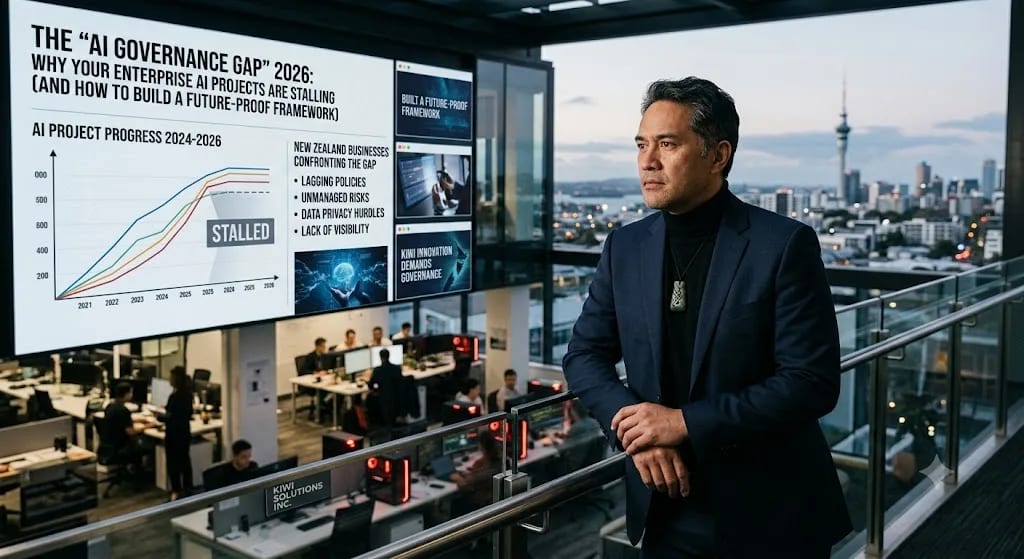
Many New Zealand businesses face an 'AI Governance Gap' in 2026, causing enterprise AI projects to stall. Learn how to build a future-proof framework.
Are your ambitious AI projects in New Zealand hitting unexpected roadblocks? Perhaps you've invested significantly in cutting-edge AI & ML solutions, only to find them struggling to move from pilot to production, or worse, facing internal resistance and compliance headaches. You're not alone. In 2026, many Kiwi businesses, from innovative startups in Wellington to established enterprises in Auckland, are discovering that building powerful AI is only half the battle. The true challenge lies in governing it effectively, ethically, and securely at scale.
New Zealand boasts a thriving startup ecosystem and a rapidly growing digital economy, valued at an estimated NZ$4.2 billion. Kiwi businesses are renowned for being early adopters of technology, increasingly turning to custom software and advanced solutions like AI to compete globally. However, as the sophistication of AI grows, so does the complexity of managing its implications. Without a robust AI governance framework 2026, your enterprise AI initiatives risk stalling, leading to wasted investment, reputational damage, and missed opportunities.
The shift from experimental AI to pervasive enterprise AI necessitates a strategic, forward-thinking approach to oversight. This isn't just about avoiding regulatory fines; it's about unlocking the full potential of AI while safeguarding your brand, your customers, and your data. From ensuring data privacy under the New Zealand Privacy Act 2020 to mitigating algorithmic bias and establishing clear accountability, effective governance is the bedrock of successful AI adoption.
In this guide, we cover what AI & ML solutions entail, why New Zealand businesses urgently need a robust AI governance framework 2026, the factors influencing implementation, typical costs and timelines, and a step-by-step approach to building a future-proof framework that will accelerate your AI projects rather than hinder them.
Table of Contents
- What are AI & ML Solutions?
- Why New Zealand Businesses Need Robust AI Governance in 2026
- The 'AI Governance Gap': Why Enterprise AI Projects Stall
- Key Factors That Affect AI Governance Framework Scope, Timeline, and Cost
- Pricing an AI Governance Framework in New Zealand (2026)
- Typical Process & Timeline for Building an AI Governance Framework
- Benefits & ROI for New Zealand Businesses from Strong AI Governance
- Common Mistakes to Avoid in AI Governance Implementation
- How to Choose the Right AI & ML Solutions Partner for Governance in New Zealand
- FAQ Section
- Why Choose Futurise Solutions?
What are AI & ML Solutions?
AI (Artificial Intelligence) and ML (Machine Learning) solutions encompass a broad spectrum of technologies designed to enable machines to perform tasks that typically require human intelligence. This includes learning from data, making predictions, recognising patterns, understanding natural language, and much more.
Defining AI & ML Solutions
At its core, AI aims to create intelligent agents that perceive their environment and take actions that maximise their chance of achieving defined goals. ML, a subset of AI, focuses on developing algorithms that allow systems to learn from data without explicit programming. This learning process enables them to improve performance on a specific task over time.
What's Included in AI & ML Solutions?
For businesses, AI & ML solutions can manifest in various forms:
- Predictive Analytics: Forecasting future trends, customer behaviour, or market shifts.
- Natural Language Processing (NLP): Enabling computers to understand, interpret, and generate human language, often seen in chatbots or sentiment analysis tools.
- Computer Vision: Allowing systems to "see" and interpret visual information, used in quality control, security, or medical imaging.
- Recommendation Engines: Personalising user experiences by suggesting products, content, or services.
- Automation & Robotics: Enhancing operational efficiency through intelligent process automation.
- Generative AI: Creating new content, designs, or code based on learned patterns.
- Custom AI Agents: Developing specialised AI to automate specific workflows or decision-making processes within your organisation.
These solutions are not just buzzwords; they represent powerful tools that can redefine how your New Zealand business operates, competes, and serves its customers. Whether it's optimising supply chains in Christchurch or personalising customer interactions in Auckland, AI offers transformative potential.
Why New Zealand Businesses Need Robust AI Governance in 2026
The rapid adoption of AI across the New Zealand digital economy, now a NZ$4.2 billion market, brings unprecedented opportunities but also significant responsibilities. Without a clear AI governance framework 2026, Kiwi businesses risk not only failing to capitalise on AI's potential but also facing substantial downsides.
Navigating the Regulatory Landscape
The New Zealand Privacy Act 2020 already sets a high bar for data handling, and as AI systems consume vast amounts of data, compliance becomes more complex. Future regulations, both local and international, are likely to impose even stricter requirements on AI's ethical use, transparency, and accountability. A strong AI compliance strategy ensures your business remains ahead of the curve.
Mitigating AI-Specific Risks
AI introduces new types of risks, including algorithmic bias, data breaches, intellectual property issues, and model explainability challenges. For instance, if an AI-powered recruitment tool inadvertently discriminates, or an autonomous system makes a flawed decision, the consequences can be severe. AI risk management is crucial for protecting your brand and your customers.
Ensuring Ethical & Responsible AI Implementation
New Zealand values fairness and transparency. Businesses deploying AI have a moral and commercial imperative to ensure their systems align with these values. This means actively addressing AI ethics in business, ensuring models are fair, transparent, and accountable. Without this, public trust, a vital asset for any business, can quickly erode.
Scaling AI Securely and Effectively
Many enterprises start with pilot AI projects, but scaling these initiatives across multiple departments or for critical operations requires a different level of oversight. How do you ensure consistency, security, and performance across dozens or hundreds of AI models? A robust AI governance framework 2026 provides the necessary structure for scaling AI securely.
Preventing Project Stalls and Maximising ROI
The primary keyword, AI governance framework 2026, addresses a core pain point: AI project failure reasons. Without clear guidelines on data quality, model validation, deployment protocols, and ethical reviews, projects can quickly become mired in uncertainty, leading to delays, cost overruns, and ultimately, failure to deliver promised value.
The 'AI Governance Gap': Why Enterprise AI Projects Stall
Many New Zealand businesses are enthusiastic about AI, but a significant gap often emerges between the ambition of AI adoption and the practical reality of managing these complex systems. This "AI Governance Gap" is a leading cause of stalled or failed enterprise AI projects.
Lack of Clear Ownership and Accountability
When an AI project is initiated, it's common for technical teams to focus on development, but who owns the ethical implications, data privacy, or post-deployment monitoring? Without clear roles and responsibilities defined within an AI governance framework 2026, critical aspects can fall through the cracks, leading to ambiguity and inaction.
Inadequate Data Governance and Quality
AI models are only as good as the data they're trained on. If your enterprise lacks robust data governance policies – covering data collection, storage, lineage, and quality – your AI models will inherit these flaws. Poor data quality can lead to biased outputs, inaccurate predictions, and a complete lack of trust in the AI system, causing projects to grind to a halt.
Insufficient Ethical Guidelines and Bias Mitigation
Simply stating that your AI will be "ethical" is not enough. Without specific, actionable guidelines on identifying and mitigating algorithmic bias, ensuring fairness, and establishing transparency, AI projects can quickly run into ethical dilemmas. These issues, if not addressed proactively, can lead to negative publicity, legal challenges, and a loss of customer trust.
Neglecting Model Explainability (XAI) and Transparency
For many critical business applications, understanding why an AI model made a particular decision is crucial. If your AI systems operate as "black boxes," it becomes nearly impossible to audit them, debug issues, or gain stakeholder confidence. Lack of explainability (XAI) can be a significant hurdle, especially in regulated industries or when the public interest is at stake.
Underestimating Security and Compliance Requirements
Deploying AI at an enterprise level introduces new security vulnerabilities and compliance obligations. Data ingress and egress points for AI models, the security of model weights, and the protection of sensitive training data all require careful consideration. A failure to embed robust security protocols and an AI compliance strategy from the outset can lead to costly data breaches or regulatory penalties.
Key Factors That Affect AI Governance Framework Scope, Timeline, and Cost
Developing and implementing a robust AI governance framework 2026 is a strategic investment. The scope, timeline, and ultimately the cost of this undertaking will vary significantly based on several critical factors specific to your New Zealand business.
Your Organisation's Size and Complexity
Larger enterprises with multiple departments, diverse AI initiatives, and complex regulatory environments will naturally require a more comprehensive and intricate enterprise AI governance framework. A small startup in Christchurch might need a streamlined approach, while a multinational corporation headquartered in Auckland will demand a far more elaborate structure.
Existing AI Maturity and Infrastructure
If your business already has several AI projects in production, with established data pipelines and deployment processes, the governance framework can be built upon existing foundations. However, if you're starting from scratch, with nascent AI capabilities, the framework will need to encompass more foundational elements, impacting both timeline and cost.
Industry and Regulatory Environment
Highly regulated industries, such as finance, healthcare, or government, will face stricter compliance requirements (e.g., the New Zealand Privacy Act 2020) and therefore need a more rigorous AI compliance strategy. The need for explainable AI (XAI), audit trails, and robust ethical reviews will be higher, adding to the complexity and resources required.
Scope of AI Applications
Are you governing a single, isolated AI chatbot, or an entire suite of interconnected AI systems that influence critical business decisions? The broader and more impactful your AI applications, the more extensive and detailed your AI governance framework 2026 will need to be, covering everything from data acquisition to model decommissioning.
Level of Customisation and Integration
Off-the-shelf governance solutions might offer a starting point, but most large New Zealand businesses will require a custom-tailored framework that integrates seamlessly with existing IT infrastructure, legal policies, and operational workflows. The degree of customisation needed directly influences development time and cost.
Internal Resources and Expertise
Do you have in-house legal, compliance, data science, and security teams with experience in AI governance? Relying on internal expertise can reduce external consulting costs, but a lack of specialised knowledge will necessitate bringing in external partners like Futurise Solutions, impacting the overall investment. Our AI & ML Solutions team can help bridge this gap.
Pricing an AI Governance Framework in New Zealand (2026)
Estimating the cost of developing and implementing a robust AI governance framework 2026 for a New Zealand business involves considering not just the initial setup but also ongoing maintenance and adaptation. While a precise figure is difficult without a detailed scope, we can provide a general range for various AI & ML solution types, acknowledging that the governance layer adds an additional, but crucial, investment.
The following table outlines estimated costs for various AI & ML solution types in New Zealand for 2026. The governance framework itself would be an additional, project-specific cost, often ranging from NZ$20,000 to NZ$150,000+ for mid-sized to large enterprises, depending on the factors discussed above. This investment covers strategy, policy development, tool integration, and training for your enterprise AI governance.
| Solution Type | Estimated Cost (NZD) | USD Equivalent |
|---|---|---|
| AI Chatbot / Assistant | NZ$5,000–NZ$15,000 | $3,000–$9,000 |
| Custom AI Agent (Single workflow) | NZ$10,000–NZ$30,000 | $6,000–$18,000 |
| LLM Integration + RAG System | NZ$15,000–NZ$50,000 | $9,000–$30,000 |
| NLP / Computer Vision Solution | NZ$25,000–NZ$90,000 | $15,000–$54,000 |
| Enterprise AI Platform | NZ$80,000–NZ$300,000+ | $48,000–$180,000+ |
Factors Influencing Governance Framework Cost:
- Consultancy Fees: Engaging experts to design, implement, and audit your AI governance framework 2026.
- Software & Tools: Licensing for AI governance platforms, monitoring tools, or compliance software.
- Legal & Compliance Reviews: Expert legal counsel to ensure adherence to the New Zealand Privacy Act 2020 and other regulations.
- Training & Education: Upskilling internal teams on responsible AI implementation and new policies.
- Documentation: Developing comprehensive policy documents, guidelines, and best practices.
- Ongoing Monitoring & Adaptation: Regular audits, policy updates, and system adjustments as AI technology and regulations evolve.
Investing in a robust AI governance framework 2026 is not an optional extra; it's a critical component of any successful enterprise AI strategy. Without it, the risks of project failure, reputational damage, and regulatory fines can far outweigh the initial investment.
Typical Process & Timeline for Building an AI Governance Framework
Building a future-proof AI policies framework is a structured process that ensures all critical aspects of enterprise AI governance are addressed systematically. While timelines can vary, a typical project for a mid-sized to large New Zealand enterprise might span several months.
| Phase | Key Activities | Estimated Timeline |
|---|---|---|
| Phase 1: Discovery & Assessment | - Current state analysis of AI initiatives & risks - Stakeholder interviews (legal, IT, data science, business units) - Review of existing policies (data privacy, security) - Identification of key governance gaps & requirements | 2-4 Weeks |
| Phase 2: Strategy & Design | - Define AI governance principles & objectives - Develop specific AI ethics in business guidelines - Design roles, responsibilities, & accountability structures - Outline data governance, model validation, & deployment policies - Map out AI compliance strategy (e.g., New Zealand Privacy Act 2020) - Select appropriate governance tools & technologies | 4-8 Weeks |
| Phase 3: Policy Development & Documentation | - Draft comprehensive AI governance policies & procedures - Create templates for AI project charters, risk assessments, & impact assessments - Develop guidelines for model explainability (XAI) & bias mitigation - Formalise security protocols for AI systems - Legal review & sign-off | 6-12 Weeks |
| Phase 4: Implementation & Integration | - Roll out new policies across relevant departments - Integrate governance processes into existing MLOps/DevOps pipelines - Implement chosen governance tools & platforms - Conduct pilot programs for new governance procedures | 8-16 Weeks |
| Phase 5: Training & Communication | - Develop training materials for all stakeholders - Conduct workshops & training sessions - Establish communication channels for governance-related queries - Foster a culture of responsible AI implementation | 2-4 Weeks |
| Phase 6: Monitoring, Review & Iteration | - Establish continuous monitoring mechanisms for AI performance & compliance - Define audit procedures & schedules - Regular review of the framework's effectiveness - Iterative improvements based on feedback & evolving regulations | Ongoing |
This phased approach ensures a comprehensive and adaptable AI governance framework 2026 that can evolve with your business and the rapidly changing AI landscape. Futurise Solutions offers comprehensive AI & ML Solutions that include the strategic development and implementation of these critical governance layers. You can see how we approach complex projects in our AI Support Agent Case Study.
Benefits & ROI for New Zealand Businesses from Strong AI Governance
Implementing a robust AI governance framework 2026 is not just about compliance or risk mitigation; it's a strategic investment that delivers tangible benefits and a significant return on investment (ROI) for New Zealand businesses.
Accelerated AI Project Delivery
By establishing clear guidelines, processes, and decision-making structures, a strong governance framework removes ambiguity and reduces AI project failure reasons. This allows your teams to innovate faster, deploy AI solutions with confidence, and move from pilot to production more efficiently, accelerating the time-to-value for your AI investments.
Enhanced Trust and Reputation
In an increasingly AI-driven world, consumer trust is paramount. A commitment to AI ethics in business and transparent, responsible AI implementation builds confidence among your customers, partners, and employees. This enhanced trust translates into stronger brand loyalty, positive public perception, and a competitive advantage in the New Zealand market.
Reduced Risks and Costs
Proactive AI risk management through a well-defined framework helps prevent costly data breaches, legal challenges stemming from bias or non-compliance (e.g., with the New Zealand Privacy Act 2020), and reputational damage. Avoiding these pitfalls can save your business significant financial resources and protect its long-term viability.
Improved Compliance and Regulatory Preparedness
With a dedicated AI compliance strategy, your business can navigate the evolving regulatory landscape with confidence. This ensures adherence to current laws and prepares your organisation for future legislative changes, reducing the likelihood of fines and legal entanglements.
Maximised Value from AI Investments
A governed approach ensures that your AI initiatives are strategically aligned with business objectives, that data quality is maintained, and that models are performing optimally. This maximises the return on your investment in AI technologies, transforming them from experimental projects into powerful drivers of growth and efficiency.
Greater Operational Efficiency and Scalability
By providing a standardised approach to AI development and deployment, an enterprise AI governance framework enables scaling AI securely. This reduces redundancy, streamlines processes, and allows your organisation to manage a growing portfolio of AI solutions efficiently across various departments, from Auckland to Christchurch.
Common Mistakes to Avoid in AI Governance Implementation
While the benefits of a strong AI governance framework 2026 are clear, many New Zealand businesses stumble during implementation. Avoiding these common pitfalls is crucial for building future-proof AI policies that genuinely support your AI initiatives.
Treating Governance as an Afterthought
One of the biggest AI project failure reasons is viewing governance as a box-ticking exercise or something to address only after an AI model is built. Governance must be integrated from the very inception of an AI project, influencing everything from data collection to model deployment and monitoring.
Over-Engineering the Framework
While comprehensive, an AI governance framework 2026 should also be practical and adaptable. Overly complex or bureaucratic frameworks can stifle innovation and create unnecessary hurdles, leading to resistance from technical teams. Start with core principles and iterate, rather than aiming for perfection from day one.
Lack of Cross-Functional Collaboration
Effective enterprise AI governance requires input and buy-in from diverse stakeholders: legal, compliance, IT, data science, business unit leaders, and even HR. Failing to involve all relevant parties can lead to frameworks that are impractical, incomplete, or lack organisational support.
Ignoring the Human Element and Training
Policies alone are not enough. Your teams need to understand why governance is important and how to implement it in their daily work. Neglecting training and communication about responsible AI implementation can lead to non-compliance and a lack of adoption.
Focusing Solely on Technology, Not Process
While AI governance tools can be helpful, they are only as effective as the processes and policies they support. A common mistake is investing in sophisticated software without first defining clear roles, responsibilities, and workflows for AI risk management and ethical oversight.
Failure to Adapt and Evolve
The AI landscape is constantly changing, with new technologies, ethical considerations, and regulations (like potential updates to the New Zealand Privacy Act 2020) emerging regularly. A static governance framework will quickly become obsolete. Your framework needs mechanisms for continuous review, adaptation, and improvement to remain future-proof AI policies.
How to Choose the Right AI & ML Solutions Partner in New Zealand
Selecting the right partner to help you build and implement your AI governance framework 2026 and deliver tailored AI & ML Solutions is a critical decision for your New Zealand business. Here’s what to look for:
Proven Expertise in AI & ML and Governance
Your partner should have a deep understanding of both cutting-edge AI technologies and the complexities of enterprise AI governance. Look for a track record of successful AI deployments and experience in developing AI compliance strategy and AI risk management frameworks. Review their Portfolio and case studies, such as our SaaS Platform Scale Case Study.
Local Market Knowledge and Global Perspective
A partner familiar with the New Zealand business landscape, including regulatory nuances like the New Zealand Privacy Act 2020, is invaluable. However, they should also bring a global perspective on AI ethics in business and emerging best practices to ensure your framework is truly future-proof AI policies.
Comprehensive Service Offering
Ideally, your partner should offer end-to-end capabilities, from initial strategy and UI/UX Design Services to Web Development Services, App Development Services, and ongoing support. This ensures a holistic approach where governance is embedded into every stage of your AI project lifecycle. Futurise Solutions provides a full suite of services, including Digital Marketing Services to help you launch your AI-powered products.
Focus on Ethical AI and Responsible Implementation
Choose a partner that prioritises responsible AI implementation and can guide you through the complexities of bias detection, fairness, and model explainability (XAI). Their commitment to AI ethics in business should be evident in their methodology and past work.
Strong Communication and Collaboration
Building an AI governance framework 2026 is a collaborative effort. Your partner should be an excellent communicator, transparent in their processes, and capable of working effectively with diverse teams within your organisation, from technical staff in Christchurch to legal teams in Wellington.
Scalability and Long-Term Partnership
As your AI ambitions grow, your partner should be able to scale their services to match. Look for a team that can support your journey from initial framework development to continuous monitoring and iterative improvements, helping you in scaling AI securely. This indicates a commitment to a long-term partnership, not just a one-off project.
FAQ Section
What is an AI governance framework?
An AI governance framework 2026 is a set of policies, procedures, roles, and responsibilities designed to manage and oversee the development, deployment, and operation of AI systems within an organisation. It ensures AI is used ethically, responsibly, securely, and in compliance with regulations like the New Zealand Privacy Act 2020.
Why is AI governance so critical for New Zealand businesses in 2026?
As AI adoption matures, the focus shifts from just building AI to managing it effectively at scale. For New Zealand businesses, robust AI governance is critical to mitigate risks (bias, data breaches), ensure compliance, build public trust, and prevent AI project failure reasons, ultimately unlocking AI's full potential for competitive advantage in the NZ$4.2 billion digital economy.
What are the main components of a future-proof AI governance framework?
Key components include clear ethical principles, data governance policies, AI risk management strategies, model explainability (XAI) guidelines, security protocols, an AI compliance strategy, defined roles and responsibilities, and mechanisms for continuous monitoring and adaptation to new regulations and technologies.
How does AI governance impact AI project timelines and costs?
Initially, implementing an AI governance framework 2026 requires an investment of time and resources. However, it significantly reduces AI project failure reasons by preventing costly errors, rework, and compliance issues down the line. It ultimately accelerates project delivery by providing clear guardrails and processes, leading to better long-term ROI.
What is "responsible AI implementation"?
Responsible AI implementation refers to the practice of developing and deploying AI systems in a manner that is fair, transparent, accountable, secure, and beneficial to society. It encompasses addressing ethical considerations, mitigating bias, protecting privacy, and ensuring human oversight.
How can Futurise Solutions help my New Zealand business with AI governance?
Futurise Solutions, based in Wellington, specialises in full-cycle digital product development, including comprehensive AI & ML Solutions. We help New Zealand businesses design, implement, and refine their AI governance framework 2026, covering strategy, policy development, technical integration, and training to ensure your AI projects are successful, ethical, and compliant. You can learn more About Futurise Solutions.
Why Choose Futurise Solutions?
At Futurise Solutions, we understand that unlocking the true power of AI for your New Zealand business in 2026 requires more than just cutting-edge technology – it demands strategic oversight and a commitment to responsible innovation. As a full-cycle digital product studio based right here in Wellington, we offer a unique blend of global expertise and local market understanding.
We don't just build AI; we build confidence. Our team excels in developing robust AI governance framework 2026 solutions that are tailored to your enterprise's unique needs, ensuring your AI initiatives are ethical, compliant, and poised for scalable success. From guiding your AI compliance strategy to embedding AI ethics in business across your operations, we partner with you every step of the way.
We pride ourselves on our proactive approach to AI risk management and our ability to craft future-proof AI policies that evolve with the rapidly changing technological and regulatory landscape. Whether you're in Auckland, Christchurch, or beyond, we empower your business to navigate the complexities of AI, transforming potential pitfalls into pathways for growth.
Ready to Get Started?
Great 2026 digital products don't build themselves — but with the right partner, the path from idea to launch is clear and fast.
👉 Book a Free 15-Minute Discovery Call
No obligation. No sales pitch. Just 15 focused minutes to understand your goals and show you exactly how we'd approach your project.
Need to discuss your project first? Contact Futurise Solutions
Or visit our Homepage to explore our complete range of services.
Related Articles
- The 'AI-Powered Brand Advocacy' Playbook for 2026: Turning Customers into Autonomous Marketing Agents
- The 'AI Agent Trust Index' 2026: Why Businesses Are Hesitant & How to Build Enterprise-Ready AI
- The 'AI-Powered Customer Journey Mapping' Playbook for 2026: Beyond Linear Funnels to Predictive Paths
- The 'AI-Powered Micro-Moment Marketing' Playbook for 2026: Capturing Intent in a Fragmented World
- The 'AI-Powered Brand Authenticity' Playbook for 2026: Building Real Trust in a Deepfake World
- The 'AI Data Moat' Strategy for 2026: How to Protect Your Unique Business Data from Generative AI & Competitors
- The 'AI-Powered Brand Empathy' Playbook for 2026: Building Deep Customer Connections in a Hyper-Personalized World
- The 'AI-Powered Brand Activism' Playbook for 2026: How to Authentically Engage in Social Issues & Build Trust
- The 'AI-Powered Brand Safety' Playbook for 2026: Protecting Your Reputation in the Age of Generative AI
- The 'AI-Powered Dark Funnel' Strategy for 2026: Uncovering & Converting Invisible Customer Journeys
Browse more expert guides on the Futurise Solutions Blog.