The 'AI Agent Trust Index' 2026: Why Businesses Are Hesitant & How to Build Enterprise-Ready AI
AI & ML · By Futurise Solutions ·
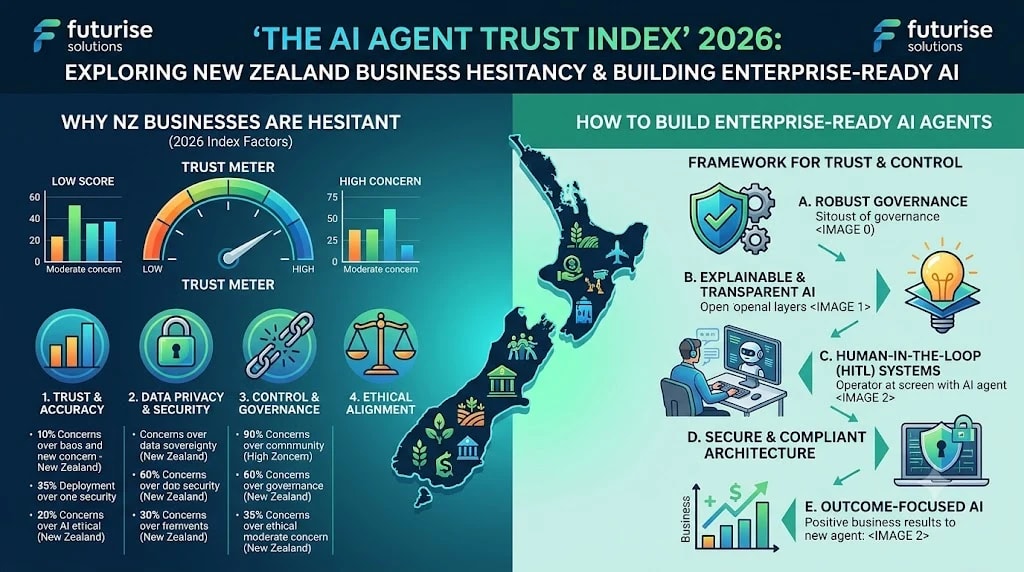
Explore why New Zealand businesses are hesitant about AI agents in 2026 and how to build enterprise-ready AI for trust and control.
In 2026, are New Zealand businesses truly ready to hand over critical operations to autonomous AI agents? While the promise of unparalleled efficiency and innovation beckons, a significant undercurrent of skepticism persists, particularly concerning reliability, ethics, and control. From the bustling tech hubs of Wellington and Auckland to the innovative agricultural sectors around Christchurch, Kiwi businesses, known for their pragmatic approach and early adoption of technology, are increasingly exploring custom software solutions to gain a global competitive edge.
New Zealand boasts a thriving startup ecosystem and a rapidly growing digital economy, valued at an estimated NZ$4.2 billion. This environment naturally fosters an appetite for advanced technologies like AI and Machine Learning (ML). However, the leap from experimenting with AI tools to deploying enterprise AI agents that operate independently within core business functions presents unique challenges. Concerns about AI "hallucinations," data privacy breaches, algorithmic bias, and ultimately, losing control, are very real.
This hesitation isn't just a gut feeling; it's a measurable phenomenon that we've termed the 'AI Agent Trust Index' 2026. This index reveals the perceived risks versus the undeniable benefits, highlighting a critical need for structured approaches to building trust. Businesses aren't questioning if AI agents can deliver value, but how to ensure they do so reliably, ethically, and securely, especially when dealing with sensitive customer data or critical operational decisions under the New Zealand Privacy Act 2020.
In this guide, we cover the core reasons for business hesitation in adopting autonomous AI agents, providing a framework for building trust and demonstrating ROI for enterprise-level deployment in the unique New Zealand market.
Table of Contents
- What are AI & ML Solutions?
- Why New Zealand Businesses Need AI & ML Solutions in 2026
- Key Factors That Affect AI Solution Cost, Scope, & Timeline
- Pricing AI & ML Solutions in New Zealand (2026)
- Typical Process & Timeline for AI & ML Solutions
- Benefits & ROI for New Zealand Businesses
- Common Mistakes to Avoid in AI Agent Deployment
- How to Choose the Right AI & ML Solutions Partner in New Zealand
- Frequently Asked Questions About AI & ML Solutions
- Why Choose Futurise Solutions?
What are AI & ML Solutions?
AI and ML solutions encompass a broad spectrum of technologies designed to enable machines to simulate human intelligence and learn from data without explicit programming. For businesses, this translates into powerful tools that automate complex tasks, make data-driven predictions, and personalise experiences at scale.
Defining Artificial Intelligence (AI)
AI refers to systems that can perform tasks requiring human intelligence, such as problem-solving, decision-making, perception, and understanding language. It's the overarching field.
Understanding Machine Learning (ML)
ML is a subset of AI that focuses on the development of algorithms allowing computers to learn from data. Instead of being explicitly programmed for every task, ML models identify patterns and make predictions or decisions based on the data they've been trained on. This is crucial for creating adaptive and evolving AI agents.
Core Components of AI & ML Solutions
- Data Collection & Preprocessing: The foundation of any AI solution. High-quality, relevant data is paramount for accurate models.
- Algorithm Selection & Model Training: Choosing the right ML algorithms (e.g., neural networks, decision trees) and training them with your prepared data.
- Model Deployment & Integration: Integrating the trained AI model into your existing systems, whether it's a CRM, ERP, or a custom application.
- Monitoring & Maintenance: Continuously tracking the model's performance, updating it with new data, and refining its behaviour. This is especially vital for maintaining trust in live AI agents.
Why New Zealand Businesses Need AI & ML Solutions in 2026
The global competitive landscape in 2026 demands more than just efficiency; it requires foresight, adaptability, and hyper-personalisation. For New Zealand businesses, AI and ML solutions are no longer a luxury but a strategic imperative to thrive in the NZ$4.2 billion digital economy.
Enhancing Global Competitiveness
Kiwi businesses, often operating on a smaller scale than international giants, can leverage AI to punch above their weight. AI agents can automate routine tasks, free up human capital for strategic initiatives, and provide data-driven insights that inform better business decisions, helping your business compete effectively on the world stage.
Driving Operational Efficiency
Imagine AI agents handling customer support inquiries, automating inventory management, or optimising logistics. This isn't futuristic; it's happening now. For example, an AI agent can process thousands of invoices in minutes, reducing manual errors and saving significant operational costs for your business.
Unlocking New Revenue Streams
AI-powered personalisation can recommend products, predict customer needs, and even co-create new services. For a retail business in Auckland, this could mean an AI system analysing purchase history to offer highly relevant promotions, leading to increased sales and customer loyalty. Similarly, an AI-driven predictive maintenance system could identify potential equipment failures before they occur, preventing costly downtime and offering new service models.
Navigating the Talent Shortage
New Zealand, like many developed nations, faces challenges in recruiting specialised talent. AI and ML solutions can augment existing workforces, taking on repetitive or data-intensive tasks, thereby allowing skilled employees to focus on higher-value activities and mitigating the impact of talent gaps.
Key Factors That Affect AI Solution Cost, Scope, & Timeline
Developing robust, trustworthy AI and ML solutions is a complex undertaking, and several factors significantly influence the overall cost, scope, and timeline for your New Zealand business. Understanding these will help you set realistic expectations and budget effectively.
Complexity of the AI Model
- Simple Automation vs. Generative AI: A basic AI chatbot for FAQ handling will be less complex and therefore less costly than a custom enterprise AI platform that uses advanced Large Language Models (LLMs) with Retrieval Augmented Generation (RAG) for nuanced customer interactions or content creation. The more sophisticated the AI's decision-making or creative capabilities, the higher the development effort.
- Data Requirements: Solutions requiring extensive data collection, cleaning, and labelling (especially for computer vision or natural language processing) will incur higher costs and longer timelines. High-quality, proprietary data is often key to building a truly effective and trustworthy AI.
Integration with Existing Systems
- API Availability: How easily can the AI solution integrate with your current CRM, ERP, or other critical business software? Well-documented APIs can streamline this process, while legacy systems might require custom connectors, increasing both cost and timeline.
- Data Synchronisation: Ensuring seamless, real-time data flow between your existing systems and the new AI solution is crucial for its effectiveness and for maintaining data integrity. Complex synchronisation needs add to the integration effort.
Level of Customisation & Specificity
- Off-the-Shelf vs. Bespoke: While some off-the-shelf AI tools exist, truly enterprise AI agent adoption often requires bespoke development tailored to your unique business processes, data, and industry regulations (like the New Zealand Privacy Act 2020). Custom solutions offer greater control and better fit but come with a higher price tag.
- Feature Set: The number and complexity of features you require from your AI agent directly impact development effort. A single-workflow AI agent focused on a specific task will be quicker and cheaper to develop than a multi-functional agent capable of handling diverse scenarios. For an example of a focused AI solution, see our AI Support Agent Case Study.
Ongoing Maintenance & Governance
- Model Monitoring & Retraining: AI models are not "set it and forget it." They require continuous monitoring to detect performance degradation (model drift) and retraining with new data to maintain accuracy and relevance. This ongoing effort is essential for building trustworthy AI agents.
- Security & Compliance: Implementing robust security measures and ensuring compliance with local regulations like the New Zealand Privacy Act 2020 adds to the development and operational costs. This includes data encryption, access controls, and auditing capabilities for AI agent governance 2026.
Pricing AI & ML Solutions in New Zealand (2026)
Understanding the investment required for AI and ML solutions in New Zealand is crucial for budget planning. In 2026, costs can vary significantly based on the complexity, customisation, and scale of the solution. Below is an estimated pricing guide for common AI and ML solution types, reflecting market rates in New Zealand Dollars (NZD) and their approximate USD equivalents (using an exchange rate of 1 NZD ≈ 0.60 USD).
| Solution Type | Estimated Cost (NZD) | USD Equivalent |
|---|---|---|
| AI Chatbot / Assistant | NZ$5,000–NZ$15,000 | $3,000–$9,000 |
| Custom AI Agent (Single workflow) | NZ$10,000–NZ$30,000 | $6,000–$18,000 |
| LLM Integration + RAG System | NZ$15,000–NZ$50,000 | $9,000–$30,000 |
| NLP / Computer Vision Solution | NZ$25,000–NZ$90,000 | $15,000–$54,000 |
| Enterprise AI Platform | NZ$80,000–NZ$300,000+ | $48,000–$180,000+ |
Breakdown of Cost Factors
- AI Chatbot / Assistant: These are generally simpler, often leveraging existing frameworks with custom training data. Ideal for basic customer service FAQs or internal support.
- Custom AI Agent (Single workflow): Designed to automate a specific, well-defined task, such as lead qualification, data entry, or a specific part of a customer service interaction. This requires more custom logic and integration.
- LLM Integration + RAG System: Involves integrating large language models with your proprietary knowledge bases (Retrieval Augmented Generation) to provide more accurate, context-aware responses, significantly reducing AI hallucinations. This is a critical step towards building trustworthy AI agents.
- NLP / Computer Vision Solution: More advanced solutions requiring specialised algorithms for understanding human language (sentiment analysis, entity recognition) or interpreting images/video (object detection, facial recognition). Examples include automated quality control in manufacturing or document analysis.
- Enterprise AI Platform: Comprehensive, custom-built AI systems designed to address multiple complex business challenges across departments. These often involve multiple AI models, extensive data pipelines, and deep integration into core business operations, embodying responsible AI agent deployment.
Beyond Initial Development Costs
It's important to factor in ongoing costs for your business:
- Infrastructure Costs: Cloud computing resources (AWS, Azure, GCP) for hosting and running your AI models.
- Maintenance & Updates: Regular monitoring, retraining, and updates to ensure the AI remains effective and secure.
- Licensing Fees: For any third-party AI tools, APIs, or data sources used.
- Data Governance & Security: Ongoing efforts to ensure data privacy and compliance.
Typical Process & Timeline for AI & ML Solutions
Implementing an AI or ML solution is an iterative process that requires careful planning, execution, and continuous refinement. Here's a typical roadmap your New Zealand business can expect when partnering with an experienced digital product studio like Futurise Solutions, alongside estimated timelines.
| Phase | Description | Key Activities | Estimated Timeline |
|---|---|---|---|
| 1. Discovery & Strategy | Define business problem, goals, and AI potential. | Workshops, requirements gathering, feasibility study, defining KPIs, risk assessment. | 2-4 Weeks |
| 2. Data Preparation | Collect, clean, and prepare data for model training. | Data sourcing, ETL (Extract, Transform, Load), data labelling, ensuring data quality & privacy. | 4-12 Weeks (Highly variable) |
| 3. Model Development & Training | Design, build, and train the AI/ML model. | Algorithm selection, model architecture design, training, validation, hyperparameter tuning. | 6-16 Weeks |
| 4. Integration & Deployment | Integrate the AI solution into existing systems and launch. | API development, system integration, testing (unit, integration, UAT), deployment to production. | 4-10 Weeks |
| 5. Monitoring & Optimisation | Continuous oversight and refinement of the AI. | Performance monitoring, A/B testing, model retraining, security audits, user feedback incorporation. | Ongoing |
Phase 1: Discovery & Strategy
This initial phase is critical for laying a solid foundation. We work closely with your team to understand your business challenges, identify specific use cases where AI can deliver tangible value, and define clear, measurable objectives. This helps us assess the feasibility of AI for your needs and align the project with your strategic goals, ensuring a clear path to demonstrating ROI for enterprise-level deployment.
Phase 2: Data Preparation
Data is the fuel for AI. This phase involves identifying, collecting, cleaning, and transforming your data into a format suitable for model training. This can be the most time-consuming phase, especially if your data is disparate, unstructured, or requires significant labelling. Adherence to the New Zealand Privacy Act 2020 is paramount here.
Phase 3: Model Development & Training
Our data scientists and ML engineers design and build the core AI model. This involves selecting the most appropriate algorithms, training them on your prepared data, and rigorously testing their performance. This iterative process ensures the model meets the defined accuracy and reliability metrics.
Phase 4: Integration & Deployment
Once the model is robust, we integrate it seamlessly into your existing IT infrastructure and applications. This might involve developing custom APIs or leveraging existing ones. Thorough testing ensures the solution functions flawlessly within your operational environment, preparing for responsible AI agent deployment.
Phase 5: Monitoring & Optimisation
AI is not a static solution. Post-deployment, we continuously monitor the model's performance, gather feedback, and implement optimisations. This includes retraining models with new data, refining algorithms, and ensuring the AI remains relevant and effective as your business evolves. This continuous feedback loop is essential for overcoming AI agent hesitation and maintaining trust.
Benefits & ROI for New Zealand Businesses
For New Zealand businesses looking to innovate and scale, investing in AI and ML solutions offers a compelling array of benefits that directly translate into significant Return on Investment (ROI). These aren't just theoretical advantages; they are tangible improvements that can redefine your operational landscape.
Enhanced Customer Experience (CX)
- Personalised Interactions: AI agents can provide 24/7, highly personalised customer support, anticipating needs and offering relevant solutions. This boosts customer satisfaction and loyalty.
- Faster Response Times: Automated chatbots and virtual assistants can handle routine inquiries instantly, freeing up human agents for complex issues. Our AI Support Agent Case Study demonstrates this in action.
- Predictive Service: AI can analyse customer behaviour to predict potential issues or needs, allowing for proactive outreach and service, significantly improving the customer journey.
Streamlined Operations & Cost Reduction
- Automation of Repetitive Tasks: AI agents excel at automating mundane, high-volume tasks like data entry, scheduling, or report generation, reducing manual effort and errors.
- Optimised Resource Allocation: ML algorithms can analyse operational data to identify inefficiencies, optimise supply chains, manage inventory, and allocate resources more effectively, leading to substantial cost savings.
- Improved Decision Making: AI provides data-driven insights, helping your business make faster, more informed decisions across various functions, from marketing strategies to financial planning.
Innovation & Competitive Advantage
- New Product & Service Development: AI can identify market gaps, analyse trends, and even assist in the design of new products or services, fostering innovation.
- Data-Driven Insights: Unlock deeper insights from your business data than ever before, revealing hidden patterns and opportunities that can inform strategic growth.
- Scalability: AI solutions can scale rapidly to meet growing demands without a proportional increase in human resources, allowing your business to grow efficiently. This is particularly valuable for scaling SaaS platforms, as seen in our SaaS Platform Scale Case Study.
Risk Mitigation & Compliance
- Fraud Detection: ML algorithms can rapidly identify anomalous patterns indicative of fraud, protecting your business from financial losses.
- Security Enhancement: AI can bolster cybersecurity by detecting unusual network activity or potential threats in real-time.
- Regulatory Compliance: AI can assist in monitoring and ensuring compliance with regulations like the New Zealand Privacy Act 2020 by automating data governance and privacy checks.
Common Mistakes to Avoid in AI Agent Deployment
While the potential of AI agents is immense, many businesses in New Zealand and globally encounter pitfalls that hinder successful deployment and erode trust. Avoiding these common mistakes is crucial for building trustworthy AI agents and achieving your desired ROI.
Lack of Clear Objectives & Strategy
- "AI for AI's Sake": Deploying AI without a clear business problem to solve or without defined KPIs is a recipe for failure. Your business needs a specific challenge that AI can demonstrably address.
- Ignoring User Needs: Failing to involve end-users in the design and testing phases can lead to AI agents that are not intuitive or helpful, hindering adoption.
Underestimating Data Quality & Quantity
- Garbage In, Garbage Out (GIGO): AI models are only as good as the data they are trained on. Poor quality, biased, or insufficient data will lead to inaccurate predictions and unreliable AI agent performance, directly impacting AI agent reliability metrics.
- Data Silos: Data trapped in disparate systems prevents a holistic view and effective AI training. A robust data strategy is essential.
Neglecting Ethical Considerations & Bias
- Algorithmic Bias: If training data contains inherent biases, the AI agent will perpetuate and even amplify them, leading to unfair or discriminatory outcomes. This is a significant concern for responsible AI agent deployment.
- Lack of Explainability: Businesses struggle to trust AI agents if they can't understand why a particular decision was made. Strive for transparent, explainable AI, especially in critical applications.
Insufficient Human Oversight & Governance
- Full Automation Fallacy: Believing AI agents can operate entirely autonomously from day one is risky. Human oversight is crucial for monitoring performance, intervening when necessary, and continuously refining the agent's behaviour.
- Ignoring Regulatory Compliance: Failing to adhere to data privacy laws like the New Zealand Privacy Act 2020 can lead to significant penalties and reputational damage. A robust AI agent governance 2026 framework is non-negotiable.
Poor Change Management & Adoption Strategy
- Lack of Internal Communication: Employees may view AI as a threat to their jobs rather than an augmentation tool. Clear communication and training are vital for internal buy-in and overcoming AI agent hesitation.
- Inadequate Training: Users need proper training to interact effectively with AI agents and leverage their capabilities fully.
How to Choose the Right AI & ML Solutions Partner in New Zealand
Selecting the right partner for your AI and ML journey is perhaps the most critical decision your New Zealand business will make. A competent partner will not only deliver technical excellence but also guide you through the complexities of building trustworthy AI agents and ensuring tangible ROI.
Proven Expertise & Track Record
- Specialised AI & ML Skills: Look for a team with deep expertise in various AI/ML domains, including data science, machine learning engineering, natural language processing, and computer vision. Ask about their specific experience with enterprise AI agent adoption.
- Relevant Case Studies: Review their portfolio and ask for case studies that demonstrate successful AI deployments in similar industries or for similar business challenges. Our AI Support Agent Case Study is a good example.
- Understanding of the NZ Market: A partner familiar with the unique business landscape, regulatory environment (like the New Zealand Privacy Act 2020), and cultural nuances of New Zealand will be better equipped to deliver relevant solutions.
A Focus on Trust & Responsible AI
- Ethical AI Framework: Enquire about their approach to ethical AI development, including how they address bias, ensure fairness, and prioritise data privacy. This is central to the 'AI Agent Trust Index' 2026.
- Explainability & Transparency: A good partner will advocate for explainable AI, helping your business understand how and why an AI agent makes its decisions.
- Security & Compliance: They should have robust data security protocols and a clear understanding of compliance requirements, especially regarding the New Zealand Privacy Act 2020.
End-to-End Service & Support
- From Strategy to Deployment: A full-cycle digital product studio like Futurise Solutions offers comprehensive services, from initial AI strategy and UI/UX design services to web development services, app development services, and crucially, ongoing support and optimisation for your AI solutions.
- Project Management & Communication: Look for a partner with strong project management methodologies and transparent communication channels to keep your business informed at every stage.
Scalability & Future-Proofing
- Modular Architecture: The solution should be built with scalability in mind, allowing for future enhancements and integrations as your business grows and AI technology evolves.
- Long-Term Partnership: Choose a partner interested in a long-term relationship, offering continuous monitoring, maintenance, and strategic advice to ensure your AI investment remains valuable.
Frequently Asked Questions About AI & ML Solutions
Navigating the world of AI and ML can bring up many questions, especially for businesses in New Zealand looking to implement these advanced technologies. Here are some common queries we encounter.
What's the difference between AI and ML?
AI (Artificial Intelligence) is the broader concept of machines performing tasks that typically require human intelligence. ML (Machine Learning) is a subset of AI that focuses on enabling systems to learn from data without explicit programming, improving performance over time. All ML is AI, but not all AI is ML.
How long does it take to develop a custom AI solution?
The timeline varies significantly based on complexity, data availability, and integration needs. A simple AI chatbot might take 2-3 months, while a comprehensive enterprise AI platform could take 6-12 months or more. Refer to our Typical Process & Timeline section for more details.
What kind of data do I need for an AI project?
You need high-quality, relevant, and sufficiently large datasets. The type of data depends on the AI's purpose – text for NLP, images for computer vision, historical performance metrics for predictive analytics. Data privacy and compliance with the New Zealand Privacy Act 2020 are paramount.
Is AI only for large enterprises?
Absolutely not. While large enterprises have the resources for complex AI platforms, many small to medium-sized businesses in New Zealand can benefit from targeted AI solutions like AI chatbots, automation agents, or predictive analytics for specific workflows. The key is identifying a clear business problem that AI can solve.
How do we ensure the AI agent is trustworthy and unbiased?
Building trustworthy AI agents involves several steps: using diverse and unbiased training data, implementing robust testing and validation processes, ensuring explainability of AI decisions, and maintaining human oversight. A strong AI agent governance 2026 framework is essential.
What's the typical ROI for AI & ML investments?
ROI varies widely but can be substantial. Businesses often see improvements in operational efficiency, cost reduction, enhanced customer experience, and the creation of new revenue streams. For instance, an AI-powered customer service agent can reduce support costs by 30% or more, while predictive analytics can increase sales by 5-10%.
What are the ongoing costs after deployment?
Ongoing costs include cloud infrastructure (hosting), continuous monitoring and retraining of the AI model, software licensing, and potential updates or enhancements. These are crucial for maintaining AI agent reliability metrics and ensuring the solution remains effective.
How does AI integrate with our existing systems?
AI solutions are typically integrated via APIs (Application Programming Interfaces) that allow them to communicate with your current CRM, ERP, or other business applications. Custom integration might be required for legacy systems. Futurise Solutions has extensive experience in seamless integration, including with web development services and app development services.
What are the security implications of AI agents?
Security is a major concern. It involves securing the data used for training, protecting the AI model itself from attacks, and ensuring the outputs are not compromised. Robust cybersecurity measures, data encryption, and access controls are vital for responsible AI agent deployment.
Can AI replace human jobs?
AI agents are primarily designed to augment human capabilities, automate repetitive tasks, and provide insights, rather than replace entire jobs. They free up human employees to focus on more complex, creative, and strategic work, enhancing overall productivity. This is key to overcoming AI agent hesitation within your workforce.
Why Choose Futurise Solutions?
When your New Zealand business is ready to navigate the complexities of AI and ML, you need a partner that combines technical prowess with a deep understanding of your strategic goals. Futurise Solutions is a full-cycle digital product studio based right here in Wellington, serving clients across Auckland, Christchurch, and globally. We don't just build technology; we craft solutions that build trust and deliver tangible value.
Our Expertise in Building Trustworthy AI
We understand the findings of the 'AI Agent Trust Index' 2026 and the hesitations many businesses face. Our approach to AI & ML Solutions prioritises:
- Responsible AI Deployment: Adhering to ethical guidelines, ensuring fairness, and mitigating bias from the ground up.
- Transparency & Explainability: Designing AI systems that provide clear rationale for their decisions, fostering confidence.
- Robust Security & Compliance: Implementing stringent data protection measures, fully compliant with the New Zealand Privacy Act 2020.
- Human-Centric Design: Integrating human oversight and feedback loops to ensure AI agents are effective, reliable, and user-friendly.
End-to-End Digital Product Partnership
From initial concept to deployment and ongoing optimisation, we offer a comprehensive suite of services. Whether you need cutting-edge UI/UX design services to ensure intuitive AI interactions, robust web development services for AI-powered platforms, or strategic digital marketing services to promote your AI-driven products, our integrated team ensures seamless execution. We're not just an AI vendor; we're your partner in digital transformation. Explore our About Futurise Solutions page to learn more about our philosophy and team.
Local Insight, Global Standards
As a Wellington-based studio, we combine an intimate understanding of the New Zealand market and its unique business culture with a commitment to global best practices. Our solutions are designed to help your Kiwi business compete and succeed, locally and internationally. We've helped businesses scale, innovate, and achieve significant ROI, as highlighted in our various case studies.
Ready to Get Started?
Great 2026 digital products don't build themselves — but with the right partner, the path from idea to launch is clear and fast.
👉 Book a Free 15-Minute Discovery Call
No obligation. No sales pitch. Just 15 focused minutes to understand your goals and show you exactly how we'd approach your project.
Need to discuss your project first? Contact Futurise Solutions
Or visit our Homepage to explore our complete range of services.
Related Articles
- The 'AI-Powered Customer Journey Mapping' Playbook for 2026: Beyond Linear Funnels to Predictive Paths
- The 'AI-Powered Micro-Moment Marketing' Playbook for 2026: Capturing Intent in a Fragmented World
- The 'AI-Powered Brand Authenticity' Playbook for 2026: Building Real Trust in a Deepfake World
- The 'AI Data Moat' Strategy for 2026: How to Protect Your Unique Business Data from Generative AI & Competitors
- The 'AI-Powered Brand Empathy' Playbook for 2026: Building Deep Customer Connections in a Hyper-Personalized World
- The 'AI-Powered Brand Activism' Playbook for 2026: How to Authentically Engage in Social Issues & Build Trust
- The 'AI-Powered Brand Safety' Playbook for 2026: Protecting Your Reputation in the Age of Generative AI
- The 'AI-Powered Dark Funnel' Strategy for 2026: Uncovering & Converting Invisible Customer Journeys
- The 'AI Shadow IT' Risk: How Unsanctioned AI Tools Are Hurting Your Business (And How to Build a Secure AI Governance Framework in 2026)
- The 'AI-Powered Brand Storytelling' Playbook for 2026: Beyond Product Features to Emotional Resonance
Browse more expert guides on the Futurise Solutions Blog.