AI Agent vs Traditional Chatbot: Which One Does Your Business Really Need in 2026?
AI Development · By Futurise Solutions ·
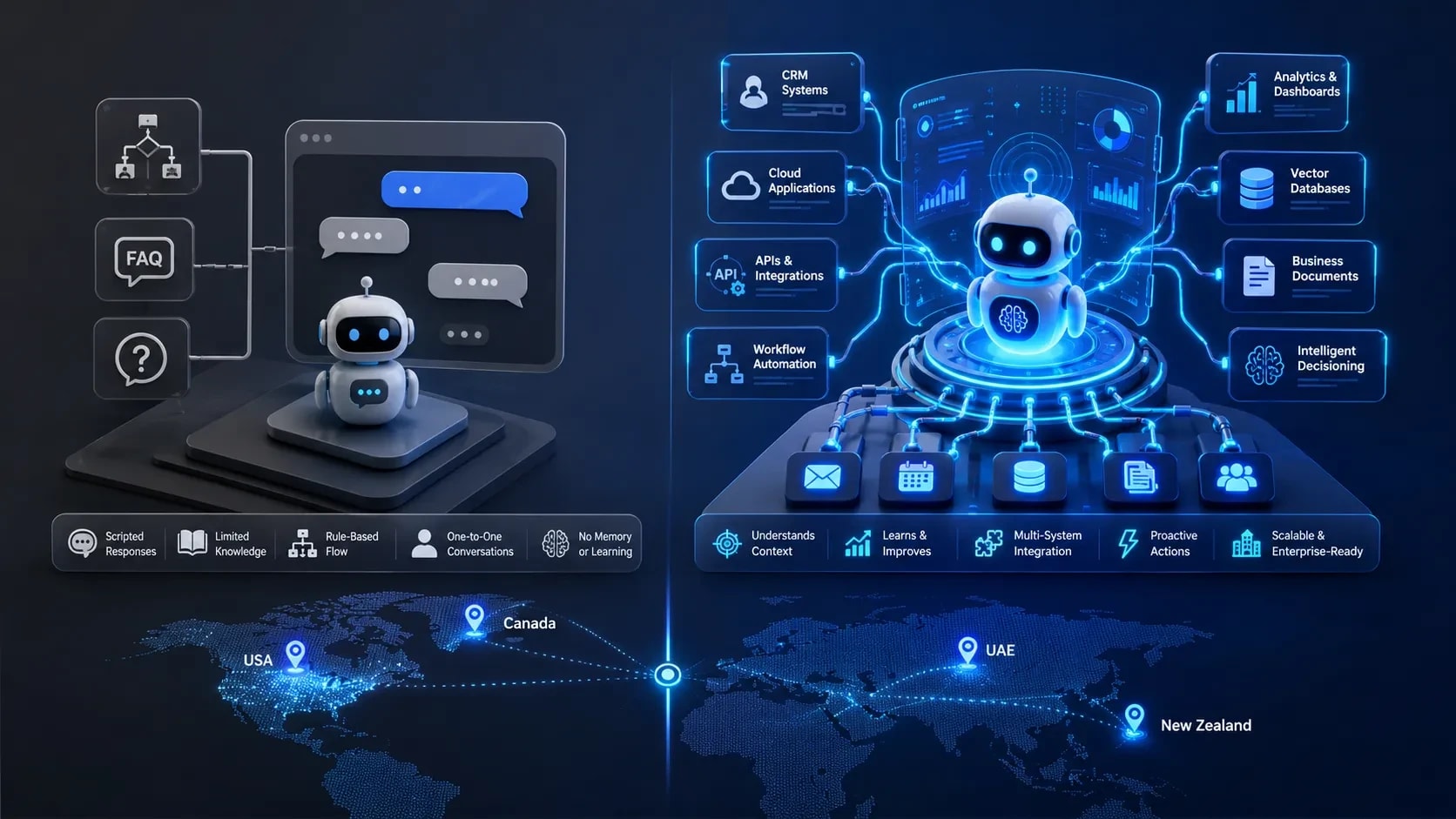
Confused between an AI agent and a traditional chatbot? Discover the key differences, business use cases, costs, capabilities, and how to choose the right AI solution for your business in 2026.
Artificial intelligence has evolved rapidly over the past few years, and businesses are no longer asking whether they should adopt AI—they're asking which AI solution is the right fit.
Two terms that are often used interchangeably are AI Agent and Traditional Chatbot. While they may seem similar on the surface, they serve very different purposes. Choosing the wrong solution can lead to unnecessary costs, poor customer experiences, and limited business value.
If you're a startup founder, CTO, product manager, or business owner planning to invest in AI, understanding this difference is essential before making any technology decisions.
In this guide, we'll compare AI agents and traditional chatbots across capabilities, business use cases, automation, intelligence, scalability, and return on investment. By the end, you'll know exactly which solution aligns with your business goals.
Table of Contents
- What Is an AI Agent?
- What Is a Traditional Chatbot?
- AI Agent vs Traditional Chatbot: Quick Comparison
- Key Differences
- Why Businesses Are Moving Beyond Chatbots
- Real-World Business Examples
- When Should You Choose a Chatbot?
- When Does Your Business Need an AI Agent?
- Cost Comparison
- Frequently Asked Questions
- Conclusion
What Is an AI Agent?
An AI agent is an intelligent software system capable of understanding context, reasoning through problems, making decisions, and completing tasks with minimal human intervention.
Unlike traditional automation tools, AI agents don't simply respond with predefined answers. They analyze user intent, access multiple data sources, interact with business applications, and execute workflows automatically.
A modern AI agent can:
- Answer customer questions using company knowledge.
- Retrieve information from internal documents.
- Update CRM records.
- Schedule meetings.
- Generate reports.
- Process invoices.
- Qualify sales leads.
- Summarize meetings.
- Analyze uploaded documents.
- Trigger automated workflows across multiple business systems.
Think of an AI agent as a digital team member that understands your business rather than just answering questions.
For example, imagine a customer asking:
"Can you send me my latest invoice and tell me whether my payment has been received?"
A custom AI agent can:
- Verify the customer's identity.
- Access the accounting system.
- Check payment status.
- Generate the latest invoice.
- Email the invoice automatically.
- Update the CRM.
- Notify the finance team if required.
The entire process can happen within seconds without manual intervention.
What Is a Traditional Chatbot?
Traditional chatbots have been around for years and are commonly used on websites to answer frequently asked questions.
Unlike AI agents, chatbots rely on predefined conversation flows, keywords, and decision trees.
They work well for repetitive tasks such as:
- Answering FAQs
- Sharing business hours
- Providing contact information
- Booking appointments
- Tracking simple orders
- Collecting customer details
For example:
Customer:
"What are your business hours?"
Chatbot:
"Our office is open Monday to Friday from 9 AM to 6 PM."
This works perfectly because the answer is predefined.
However, if the customer asks:
"Can you check whether my project milestone has been approved and notify my project manager?"
A traditional chatbot usually cannot perform this task because it lacks access to business systems and cannot reason beyond predefined rules.
AI Agent vs Traditional Chatbot: Quick Comparison
| Feature | Traditional Chatbot | AI Agent |
|---|---|---|
| Intelligence | Rule-based | Context-aware |
| Learning Ability | Limited | Advanced |
| Decision Making | No | Yes |
| Workflow Automation | Basic | Advanced |
| API Integrations | Limited | Extensive |
| Business Knowledge | Minimal | Deep |
| Handles Complex Requests | No | Yes |
| Multi-Step Tasks | No | Yes |
| Personalized Responses | Limited | Yes |
| Enterprise Ready | Limited | Yes |
The biggest difference is simple:
A chatbot answers questions.
An AI agent completes work.
Key Differences Between AI Agents and Traditional Chatbots
1. Intelligence
Traditional chatbots depend on predefined scripts.
If a question falls outside the programmed conversation flow, they often fail to provide useful answers.
AI agents understand context, recognize intent, and adapt their responses based on available business information.
Instead of searching for exact keywords, they understand what the user actually wants.
2. Business Automation
Chatbots mainly communicate.
AI agents automate.
For example, an AI agent can:
- Read an email.
- Extract important information.
- Generate a support ticket.
- Assign it to the correct department.
- Notify the customer.
- Schedule a follow-up.
- Update internal systems.
All of this happens automatically.
3. System Integrations
Businesses today use multiple platforms, including:
- Salesforce
- HubSpot
- Microsoft Dynamics
- Slack
- Microsoft Teams
- Google Workspace
- Xero
- QuickBooks
- Jira
- Shopify
Traditional chatbots usually have limited integration capabilities.
AI agents can securely connect with these systems through APIs, retrieve data, and perform actions without requiring manual effort.
4. Understanding Context
Imagine a customer asks:
"Can I change my delivery address?"
The customer then follows up with:
"Actually, send it to my office instead."
A chatbot may lose the conversation context.
An AI agent remembers previous messages, understands references like "my office," and continues the conversation naturally.
This creates a significantly better customer experience.
5. Decision-Making Capabilities
Chatbots respond.
AI agents evaluate.
For example:
If a customer requests a refund, an AI agent can:
- Verify purchase history.
- Check refund policy.
- Review payment records.
- Detect potential fraud.
- Initiate the refund automatically.
- Notify the finance department.
- Inform the customer.
These capabilities make AI agents valuable for enterprise automation.
Why Businesses Are Moving Beyond Traditional Chatbots
The expectations of customers have changed dramatically.
People no longer want scripted conversations that end with:
"Please contact our support team."
Instead, they expect AI systems to solve problems instantly.
This shift has encouraged businesses across industries to adopt intelligent AI agents that provide real business value.
Some of the biggest reasons include:
Higher Productivity
AI agents reduce repetitive manual work, allowing employees to focus on strategic tasks.
Instead of spending hours updating spreadsheets or responding to repetitive emails, teams can focus on innovation and customer relationships.
Faster Customer Support
Customers expect immediate responses.
AI agents provide:
- 24/7 availability
- Personalized responses
- Faster issue resolution
- Intelligent recommendations
- Consistent service quality
This improves customer satisfaction while reducing support costs.
Better Decision-Making
AI agents can analyze information from multiple business systems before providing recommendations.
Instead of simply displaying information, they summarize insights and help decision-makers act faster.
Improved Employee Experience
Internal AI agents help employees quickly find company policies, technical documentation, project information, HR guidelines, and product knowledge without searching through hundreds of files.
The result is higher productivity across the organization.
Real-World Business Examples
Example 1: E-commerce
Traditional Chatbot
- Shares shipping policy
- Answers return FAQs
- Provides contact information
AI Agent
- Tracks orders
- Updates delivery addresses
- Processes returns
- Issues refunds
- Recommends products
- Detects fraudulent transactions
Example 2: Healthcare
Traditional Chatbot
- Books appointments
- Shares clinic timings
AI Agent
- Retrieves patient history
- Summarizes medical records
- Assists healthcare professionals
- Automates documentation
- Schedules follow-up visits
Example 3: SaaS Business
Traditional Chatbot
- Answers pricing questions
- Shares feature documentation
AI Agent
- Qualifies leads
- Schedules product demos
- Updates CRM
- Generates proposals
- Sends follow-up emails
- Creates customer onboarding tasks
Businesses investing in AI are increasingly choosing intelligent agents because they deliver measurable operational improvements rather than simply answering questions.
If you're exploring custom AI solutions, you may also find our guide on How Much Does It Cost to Build a Custom AI Agent in 2026? helpful for understanding pricing, timelines, and development considerations. You can also explore our AI & ML Solutions services to see how custom AI agents can be tailored for different industries.
When Should You Choose a Traditional Chatbot?
Despite the rapid growth of AI agents, traditional chatbots still play an important role in many businesses. If your goal is to answer common customer questions or provide simple support without integrating multiple business systems, a chatbot can be a practical and budget-friendly solution.
A traditional chatbot is ideal if your business needs to:
- Answer frequently asked questions (FAQs)
- Share business hours and contact information
- Book appointments
- Capture customer inquiries
- Track orders
- Route conversations to support teams
- Provide product or service information
For startups and small businesses just beginning their automation journey, a chatbot is often the quickest way to improve customer engagement.
However, as your business grows and customer expectations increase, you may need a more intelligent solution that can automate complete workflows rather than simply respond to messages.
If you're evaluating the investment required for advanced AI solutions, read our guide on How Much Does It Cost to Build a Custom AI Agent in 2026?.
When Does Your Business Need an AI Agent?
A custom AI agent is designed for businesses that want to automate operations, improve productivity, and connect multiple business applications into one intelligent workflow.
An AI agent is the better choice if you want to:
- Automate repetitive business processes
- Connect CRM, ERP, HRMS, and accounting software
- Reduce manual work
- Improve employee productivity
- Deliver personalized customer experiences
- Generate reports automatically
- Analyze business data
- Build an AI-powered knowledge assistant
- Qualify sales leads
- Scale operations without significantly increasing headcount
Unlike traditional chatbots, AI agents can understand context, make decisions, and perform actions across multiple systems.
Businesses looking to implement enterprise-grade AI solutions can explore our AI & ML Solutions, where we build custom AI agents, LLM-powered applications, workflow automation, and intelligent business solutions.
AI Agent vs Traditional Chatbot: Cost Comparison
Although pricing varies depending on project complexity, the following estimates provide a realistic overview.
| Solution | Estimated Cost (USD) |
|---|---|
| Basic Rule-Based Chatbot | $1,000–$5,000 |
| Advanced Chatbot | $5,000–$15,000 |
| Custom AI Agent | $15,000–$80,000 |
| Enterprise AI Platform | $80,000–$250,000+ |
A chatbot usually requires a smaller upfront investment, but its capabilities are limited.
An AI agent requires a higher initial investment but delivers substantially greater value by automating business operations, reducing manual effort, and improving decision-making across departments.
For a detailed breakdown of pricing, development phases, and timelines, explore our Complete AI Agent Cost Guide.
Which Solution Delivers Better ROI?
Many organizations compare development costs while overlooking long-term business impact.
A chatbot improves customer communication.
An AI agent improves the entire organization.
AI agents can automate workflows across:
- Customer Support
- Sales
- Human Resources
- Finance
- Operations
- Marketing
- Project Management
- Internal Knowledge Management
Instead of saving a few minutes on customer conversations, businesses often save hundreds of employee hours every month through intelligent automation.
This is one of the main reasons organizations across the USA, Canada, New Zealand, and the UAE are investing heavily in enterprise AI initiatives.
Industry Recommendations
SaaS Companies
Modern SaaS businesses use AI agents to:
- Qualify leads automatically
- Schedule product demonstrations
- Update CRM records
- Generate proposals
- Improve customer onboarding
- Summarize customer conversations
If you're planning to build an AI-powered SaaS platform, don't miss our detailed guide on How to Build a Custom AI Agent for Your Business.
Healthcare
Healthcare providers are increasingly adopting AI agents to:
- Retrieve patient information
- Summarize medical records
- Reduce administrative workload
- Schedule follow-up appointments
- Assist healthcare professionals with documentation
These capabilities improve operational efficiency while allowing medical professionals to spend more time with patients.
Finance
Financial institutions use AI agents to automate:
- Customer onboarding
- Compliance verification
- Fraud detection
- Loan document processing
- Financial reporting
- Internal approvals
Because AI agents integrate with multiple enterprise systems, they significantly reduce repetitive administrative work while improving accuracy.
Real Estate
Real estate businesses are using AI agents to automate repetitive processes while delivering faster and more personalized customer experiences.
AI agents can:
- Qualify buyer and seller inquiries
- Recommend suitable properties
- Schedule property visits
- Generate personalized follow-up emails
- Update CRM records automatically
- Answer property-related questions 24/7
To see how modern technology is transforming the real estate industry, explore our Real Estate App Case Study.
eCommerce
For eCommerce businesses, AI agents can automate:
- Product recommendations
- Order tracking
- Returns and refunds
- Customer support
- Inventory-related queries
- Post-purchase engagement
Unlike traditional chatbots, AI agents understand customer preferences and purchase history, creating a more personalized shopping experience.
Common Mistakes Businesses Make
Many businesses fail to achieve the expected ROI from AI because they focus on technology before solving business problems.
Some common mistakes include:
- Choosing a chatbot when an AI agent is actually needed
- Ignoring API integrations
- Poor data quality
- Focusing only on development cost
- Ignoring user experience
- Not planning for future scalability
- Overlooking security and compliance
- Not measuring business outcomes
Avoiding these mistakes helps organizations maximize the value of their AI investment.
Best Practices Before Investing in AI
Before choosing between a chatbot and an AI agent, ask yourself:
- What business problem are we solving?
- Which repetitive tasks consume the most employee time?
- Which systems need to communicate?
- What level of automation do we need?
- How will success be measured?
Starting with clear business objectives leads to better implementation, faster adoption, and stronger long-term ROI.
AI Agent vs Traditional Chatbot: Final Verdict
| Business Requirement | Traditional Chatbot | AI Agent |
|---|---|---|
| Answer FAQs | ✅ | ✅ |
| Understand Context | ❌ | ✅ |
| CRM & ERP Integration | Limited | ✅ |
| Workflow Automation | ❌ | ✅ |
| Generate Reports | ❌ | ✅ |
| Personalized Responses | Limited | ✅ |
| Multi-Step Decision Making | ❌ | ✅ |
| Enterprise Ready | Limited | ✅ |
| Future Scalability | Limited | Excellent |
If your business only needs to answer simple customer questions, a traditional chatbot may be enough.
However, if your goal is to automate operations, improve productivity, connect multiple business systems, and deliver intelligent customer experiences, investing in a custom AI agent is the smarter long-term decision.
Frequently Asked Questions
Can an AI agent replace a chatbot?
Yes. Modern AI agents can perform all chatbot functions while adding intelligent decision-making, workflow automation, and enterprise integrations.
Are AI agents suitable for startups?
Absolutely. Many startups begin with a focused AI solution and expand its capabilities as the business grows.
Which industries benefit the most from AI agents?
Healthcare, Finance, SaaS, Retail, Manufacturing, Logistics, Real Estate, Education, and Professional Services all benefit from AI-powered automation.
Are AI agents expensive?
While AI agents typically require a higher upfront investment than chatbots, they often generate significantly greater long-term ROI through automation and productivity improvements.
Can AI agents integrate with existing business software?
Yes. AI agents can integrate with CRM systems, ERP platforms, HR software, accounting applications, cloud platforms, internal databases, and custom APIs.
Where can I learn more about Futurise Solutions?
Visit our About Us page to learn how we help businesses build scalable AI, SaaS, and custom software solutions.
Why Businesses Choose Futurise Solutions
At Futurise Solutions, we specialize in helping startups, SMEs, and enterprises build intelligent digital products that solve real business challenges.
Our expertise includes:
- AI & ML Solutions
- Web Development
- App Development
- UI/UX Design
- Blockchain Development
- Digital Marketing
- Workflow Automation
- Enterprise Software Development
You can also explore our Portfolio to see how we've helped businesses launch successful digital products.
Interested in a real-world AI implementation? Read our AI Support Agent Case Study to discover how we built an AI-powered support solution that improved efficiency and customer experience.
Ready to Transform Your Business with AI?
Whether you're planning your first AI initiative or looking to replace a traditional chatbot with a custom AI agent, our team is here to help.
We work with businesses across the USA, Canada, New Zealand, UAE, and beyond, delivering AI-powered solutions that improve productivity, streamline operations, and drive measurable business growth.
🚀 Book a Free 45-Minute Strategy Call
Have questions before getting started?
Or visit our Homepage to explore our AI, software development, UI/UX design, blockchain, mobile app development, and digital marketing services.
Related Articles
- How Much Does It Cost to Build a Custom AI Agent in 2026?
- How to Build a Custom AI Agent for Your Business
- AI & ML Solutions: Custom AI Agents, LLM Integrations, NLP and Computer Vision
- Unlocking Dubai's AI Future
- Scaling Kiwi Startups with Custom AI & SaaS Integrations
👉 Explore more insights on the Futurise Solutions Blog.