How to Build a Custom AI Agent for Your Business: The Complete 2026 ROI & Tech Stack Guide for US and Canadian Startups
AI & Technology · By Futurise Solutions ·
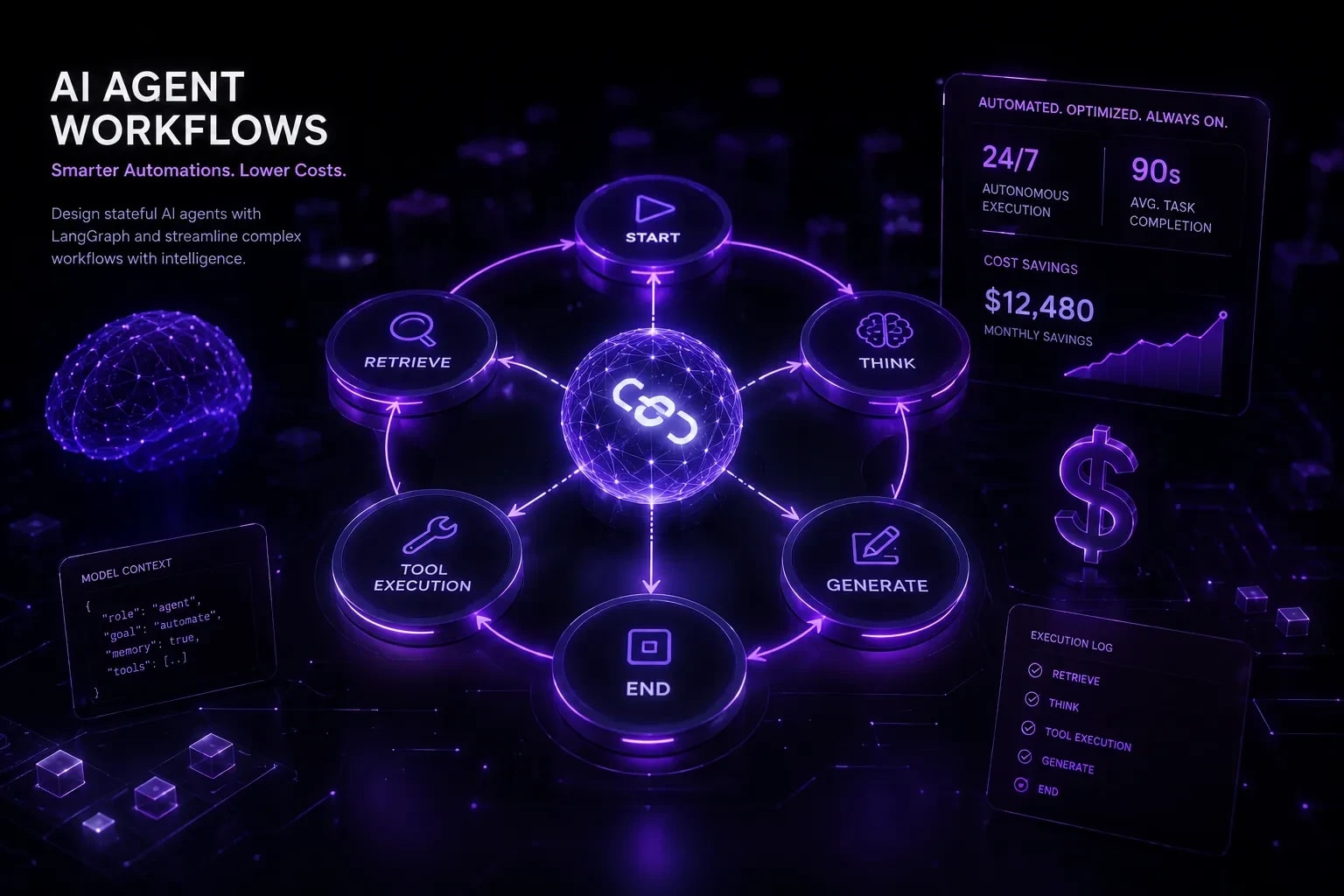
Discover how much it costs to build a custom AI agent in 2026. This complete technical guide breaks down developmental budgets, workflow ROI, and LangChain vs. LangGraph orchestrations for growing businesses in the US and Canada.
In 2026, the discussion around artificial intelligence has shifted. US and Canadian startups are no longer satisfied with simple API prompt wrappers or basic generative chatbots that output raw text. In a competitive market spanning major hubs like San Francisco, Toronto, Vancouver, and New York, scaling businesses are implementing autonomous AI agents—systems capable of reasoning, planning, executing workflows, and coordinating with existing software tools to drive real-world outcomes.
The challenge for CTOs and founders isn't finding the models; it's understanding the engineering path, selecting the right orchestration framework, estimating realistic development costs, and auditing the return on investment (ROI).
This guide outlines the technical requirements, frameworks, compliance parameters (such as SOC 2 and HIPAA), and cost breakdowns for building custom AI agents in North America.
What is an Autonomous AI Agent?
An autonomous AI agent is an advanced software system that leverages a large language model (LLM) as its core reasoning engine. Unlike a chatbot, which simply responds to user inputs in a conversational cycle, an agent is designed to receive a high-level goal (e.g., "Qualify inbound leads and book them into HubSpot") and determine its own sequence of steps, execute those actions using external tools, verify the results, and recover from errors autonomously.
Key characteristics of production-grade agents include:
- Planning & Reasoning: Breaking complex goals into sub-tasks using reasoning techniques like Chain-of-Thought (CoT) or ReAct (Reason + Action).
- Tool Orchestration: Interacting with databases, calling REST/GraphQL APIs, executing sandboxed code, and modifying files.
- Memory Systems: Utilizing short-term memory (in-context buffers) and long-term memory (vector databases like pgvector or Pinecone) to retain context across multi-session workflows.
- State Management: Persisting execution paths so tasks can pause for human approval and resume without losing context.
Explore our AI & ML Solutions →
/service/ai-ml-solutions
The 2026 AI Agent Cost Matrix
When budgeting for AI agent development, the scope depends heavily on the level of autonomy, integration complexity, and safety parameters. Below is a realistic pricing matrix based on development projects delivered for clients in the US and Canada.
| Agent Class | Typical Cost Range (USD/CAD) | Core Capabilities | Development Timeline | Ideal For |
|---|---|---|---|---|
| Prototype / MVP Agent | $15,000 – $35,000 | Linear workflows, single-agent architecture, basic vector search, standard API calls (Slack, HubSpot, etc.) | 4 – 8 Weeks | Startups validating product-market fit or testing workflows |
| Contextual Multi-Tool Agent | $40,000 – $110,000 | Non-linear routing, custom RAG, memory, human-in-the-loop validation, error handling | 3 – 5 Months | Business process automation |
| Autonomous Enterprise Swarm | $120,000 – $350,000+ | Multi-agent coordination, fine-tuning, SOC 2/HIPAA/PIPEDA compliance, state persistence, self-healing | 6 – 9+ Months | Enterprise finance, healthcare, SaaS |
Note: Operating costs (token usage, vector storage, monitoring, hosting) typically range from $400–$6,000+ per month, depending on model selection and traffic volume.
LangChain vs. LangGraph: Choosing Your Orchestration Stack
Selecting the right orchestration framework is one of the most important architectural decisions you'll make. While LangChain remains popular for straightforward applications, complex AI agents benefit from graph-based orchestration.
Comparing the Tech Stacks
| Feature | LangChain | LangGraph | Best Use Case |
|---|---|---|---|
| Execution Pattern | Linear Chains (DAGs) | Cyclical Graphs (State Machines) | LangGraph supports iterative reasoning and retries |
| State Management | Context-bound | Persistent State | LangGraph enables pause/resume workflows |
| Agent Collaboration | Single-Agent | Multi-Agent | LangGraph excels at coordinating specialized agents |
| Debugging & Monitoring | LangSmith | LangSmith + Graph Visualization | Better observability for complex workflows |
When to Use LangGraph
For enterprise-grade AI agents, LangGraph is generally the preferred orchestration framework because business workflows are rarely linear.
Instead of executing a single sequence of steps, agents often need to:
- Retry failed actions
- Wait for human approval
- Branch into different decision paths
- Recover from API failures
- Coordinate multiple specialized agents
LangGraph models these workflows as a graph consisting of nodes (tasks) and edges (decision paths), enabling robust state management and execution control.
Key Cost Drivers for North American Startups
Understanding where your budget goes helps prevent unexpected project delays.
1. Data Preparation & Custom Embeddings
Before an AI agent can reason effectively, enterprise data must be:
- Extracted
- Cleaned
- Chunked
- Embedded
- Indexed
Building these pipelines often represents 25–35% of total project effort.
2. Integration Overhead
An AI agent is only as valuable as the systems it can interact with.
Typical integrations include:
- CRM platforms
- ERP systems
- Internal databases
- Payment gateways
- Document management systems
Engineering effort includes:
- Secure authentication
- API rate limiting
- Token refresh
- Error handling
- Database write-backs
Many teams encapsulate integrations within microservices to maintain modularity.
3. Compliance & Security (SOC 2, HIPAA, PIPEDA)
For Canadian startups (PIPEDA) and US organizations operating under HIPAA or SOC 2 requirements, security engineering becomes a major project component.
Typical safeguards include:
- Audit logging
- PII masking
- Role-based access control
- Encryption at rest and in transit
- Private VPC deployment
- Secret management
- Human approval workflows
These investments increase project scope but are often essential for enterprise adoption.
How to Calculate the ROI of an AI Agent
A simple framework for estimating ROI:
Formula
Annual ROI =
(Manual Workflow Cost − AI Agent Cost)
− AI Operating Overhead
Where:
- Manual Workflow Cost = Hours per week × Hourly wage × 52
- AI Agent Cost = One-time implementation cost amortized over two years
- AI Operating Overhead = Tokens + Hosting + Monitoring + Infrastructure
Example: Inbound Sales Qualification
Before
A US B2B SaaS startup employs two junior sales representatives.
- Salary per rep: $55,000/year
- Total annual labor cost: $110,000
Tasks include:
- Lead qualification
- LinkedIn research
- Salesforce updates
After
A LangGraph-powered AI agent performs the same workflow.
- Development cost: $45,000
- Annual infrastructure cost: $4,200
Savings
| Year | Savings |
|---|---|
| Year 1 | $60,800 |
| Year 2 | $105,800 |
The human sales team can instead focus on outbound selling and revenue generation.
Build vs. Buy: Decision Framework
Buy (Low-Code / SaaS)
Choose an off-the-shelf solution if your workflow:
- Is relatively simple
- Doesn't require proprietary data
- Doesn't require advanced reasoning
- Can be automated using platforms like Zapier or Microsoft Copilot Studio
Benefits:
- Lower upfront cost
- Faster deployment
- Minimal engineering effort
Build (Custom AI Agent)
Custom development is the better option when you require:
- Complex decision making
- Multiple software integrations
- Long-term memory
- Custom RAG
- SOC 2 or HIPAA compliance
- White-label deployment
- Integration into your own SaaS product
Benefits include:
- Full IP ownership
- No vendor lock-in
- Better performance
- Complete architectural control
How Futurise Solutions Builds Custom AI Agents
At Futurise Solutions, we partner with startups across the US and Canada to build production-ready AI systems.
1. Discovery & Data Audit
We evaluate:
- Existing data
- Target workflows
- Business KPIs
- Technical constraints
2. Orchestration & Prototyping
Within approximately four weeks, we deliver a working prototype using:
- LangGraph
- GPT-4o
- Claude
- Retrieval-Augmented Generation (RAG)
This allows stakeholders to validate workflows before full-scale development.
3. Compliance & Guardrails
We implement:
- PII masking
- Safety filters
- Human approval checkpoints
- Prompt protection
- Access controls
to reduce hallucinations and improve operational safety.
4. Production Deployment & Monitoring
Deployment includes:
- AWS or Google Cloud
- CI/CD pipelines
- LangSmith monitoring
- Cost dashboards
- Latency tracking
- Token usage analytics
Ready to Automate Your Operations?
Book a Free 45-Minute AI Strategy Call →
/contact
We'll review your workflow, recommend an appropriate architecture, and provide an honest estimate for timeline, budget, and implementation strategy.
Futurise Solutions is a global digital product studio specializing in Custom AI Agent Development, SaaS Platforms, Web & Mobile App Development (React Native & Expo), and Blockchain solutions for startups and enterprises across North America, Dubai, and New Zealand.