Unlocking Dubai's AI Future: How UAE Businesses Are Implementing Autonomous AI Agents & Web3 Platforms under the National AI Strategy 2031
AI & Technology · By Futurise Solutions ·
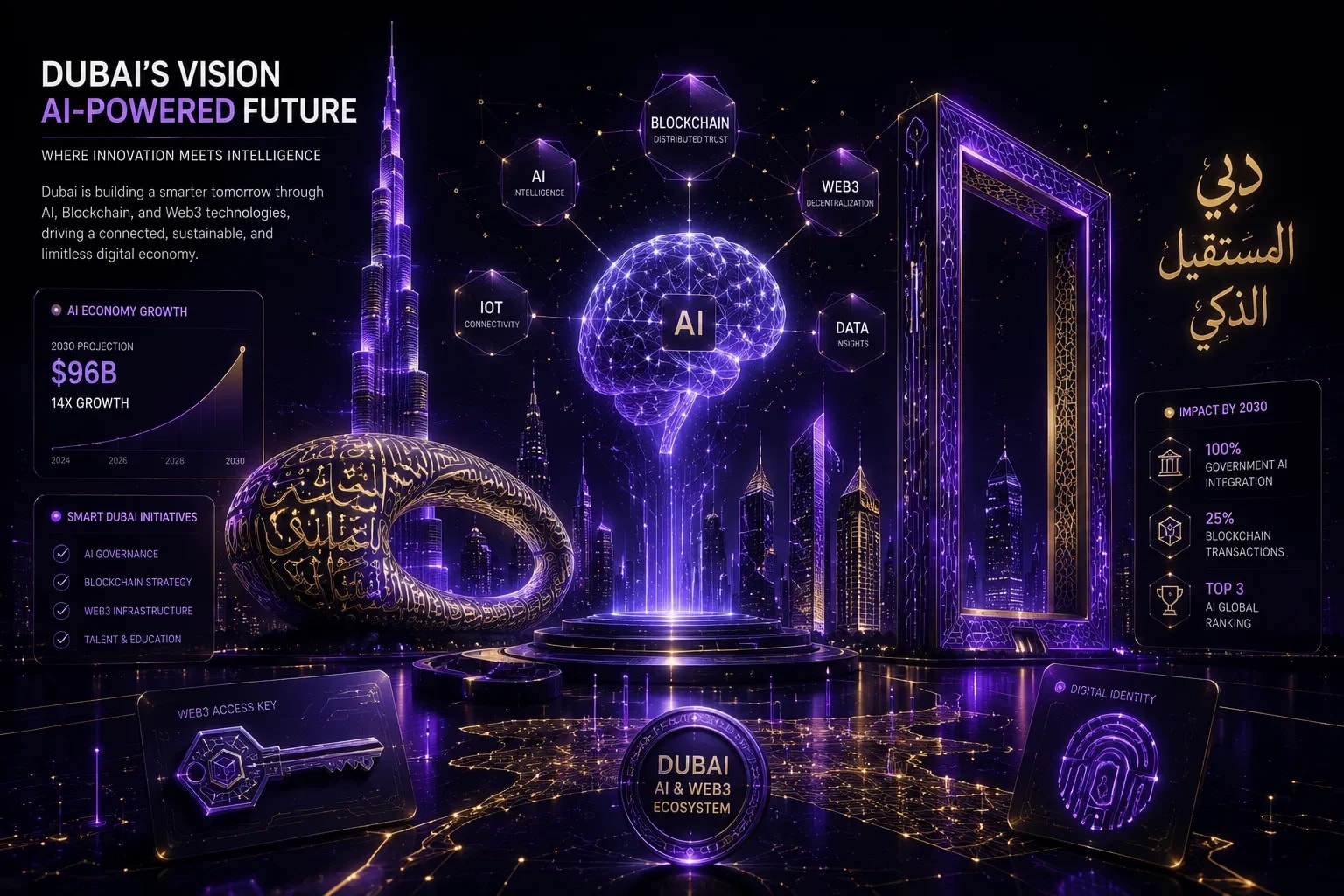
Discover how Dubai enterprises are integrating autonomous AI agents and custom Web3 frameworks to stay compliant and scale under the UAE National Strategy for AI 2031.
Dubai is no longer just a financial capital or architectural marvel—it is rapidly establishing itself as the global capital of artificial intelligence and digital product innovation. Driven by the ambitious UAE National Strategy for AI 2031, the Gulf region is witnessing a transition from initial technology exploration to deep, production-grade integration.
From high-growth scaleups in the Dubai International Financial Centre (DIFC) and Abu Dhabi Global Market (ADGM) to massive real estate developers and logistics giants at Jebel Ali Port, businesses are deploying autonomous AI agents and custom Web3 platforms to scale operations, reduce overhead costs, and build sovereign data ecosystems.
This article explores how UAE enterprises are implementing custom AI and blockchain solutions, navigating regulatory frameworks, and maximizing operational ROI.
The UAE National Strategy for AI 2031: An Enterprise Perspective
The UAE National Strategy for AI 2031 is a government-led initiative designed to position the UAE as a global leader in artificial intelligence by 2031.
For business leaders, CTOs, and technology decision-makers operating in Dubai, this strategy provides:
Sovereign AI Infrastructure
- Organizations are encouraged to leverage locally hosted infrastructure and regional AI models (such as the open-source Falcon LLM developed in Abu Dhabi) to ensure data sovereignty.
Regulatory Support
- Free zones like DIFC and ADGM provide regulatory sandboxes where fintech companies can safely test AI-powered trading algorithms and autonomous smart contracts.
Data Localization
- Sensitive financial, healthcare, and government information must remain inside UAE-based data centers such as e& enterprise or Khazna, making secure hybrid-cloud deployment architectures essential.
Explore our Web Development Services →
/service/web-development
How AI Agents Are Transforming Key Industries in Dubai
Unlike traditional automation scripts, autonomous AI agents can reason through tasks, interact with external APIs, and manage complex workflows in real time.
Several industries across Dubai are already seeing measurable business value.
1. Real Estate & Property Management
Dubai's real estate market is highly competitive, making AI-powered automation a significant competitive advantage.
Common use cases include:
Lead Qualification Agents
- Answer investor questions about payment plans, rental yields, freehold ownership, and locations in multiple languages 24/7.
Automated Viewing Coordination
- Schedule property viewings, synchronize with agent calendars, and send SMS or WhatsApp confirmations automatically.
2. Fintech & Wealth Management (DIFC & ADGM)
Financial institutions operating inside regulatory sandboxes are increasingly adopting intelligent AI workflows.
Examples include:
KYC & Onboarding Agents
- Verify identification documents, review corporate registries, perform AML checks, and escalate suspicious cases.
Document Extraction Agents
- Process investment portfolios, summarize financial reports, extract charts, and generate structured client reports.
3. Trade & Logistics (JAFZA)
As one of the world's busiest logistics hubs, Dubai relies heavily on document-intensive operations.
AI agents streamline processes such as:
Customs Documentation
- Read shipping manifests, classify HS codes, validate import restrictions, and pre-fill customs declarations.
Dispatch Optimization
- Dynamically assign shipping schedules using traffic conditions, weather alerts, and port capacity.
Technical Architecture for UAE AI Implementations
Building enterprise AI systems in Dubai requires engineering decisions that address:
- Data residency
- Arabic language support
- Regulatory compliance
- Infrastructure security
graph LR
    A[Arabic/English User] --> B[Dynamic Translation Layer]
    B --> C[Private UAE VPC - e& / Khazna]
    C --> D[Local RAG Engine]
    C --> E[Compliance & PII Masking]
    D --> F[Enterprise Database]
    E --> G[Sovereign / Frontier Models]
The Arabic Language Challenge
Standard LLMs often struggle with Gulf Arabic dialects.
To improve customer experience, a hybrid AI architecture is commonly implemented.
1. Intent Recognition
A lightweight language model identifies whether user input is:
- English
- Modern Standard Arabic (MSA)
- Gulf Arabic (Khaleeji)
2. Translation Layer
Regional dialects are converted into structured Arabic or English before reaching the reasoning engine, improving accuracy and consistency.
3. Sovereign AI Models
Organizations often combine:
- Falcon 180B
- GPT-4o
- Other frontier AI models
This hybrid approach balances privacy, compliance, and performance.
Data Compliance & Local VPC Hosting
To comply with UAE regulations:
- AI databases are hosted inside private VPCs.
- Deployments use AWS UAE Regions or local cloud providers such as e&.
- Personally Identifiable Information (PII) is masked before requests reach public LLM endpoints.
This architecture ensures enterprise-grade security while remaining compliant with local regulations.
The Intersection of AI and Web3 in Dubai
Dubai's Virtual Assets Regulatory Authority (VARA) has positioned the city as a global hub for blockchain innovation.
Many organizations are combining AI agents with Web3 platforms to automate decentralized workflows.
AI-Managed Escrow
Smart contracts running on:
- Ethereum
- Arbitrum
- Solana
can automatically release payments once AI agents verify documentation such as:
- Title deeds
- Customs clearance
- Contract completion
Automated Yield Optimization
AI continuously monitors:
- Market volatility
- DeFi protocols
- Risk metrics
Smart contracts then rebalance capital automatically based on AI-generated recommendations.
Learn more about Blockchain Development →
/service/blockchain-development
Deploying AI in Dubai: VARA, DIFC & ADGM Compliance Checklist
| Compliance Area | Requirements | Recommended Strategy |
|---|---|---|
| Data Residency | Financial and PII data must remain inside UAE data centers. | Deploy local VPCs or on-premise infrastructure using AWS UAE Regions. |
| VARA Compliance | Virtual asset businesses require active licensing. | Integrate KYC, AML verification, and immutable audit logs. |
| AI Fairness & Auditing | AI outputs should be explainable and transparent. | Store prompts, evaluations, and RAG histories using observability tools such as LangSmith. |
| Sovereign Backups | Critical systems should not rely solely on US-based AI APIs. | Build fallback execution paths using locally hosted Falcon or Llama models. |
Partner with Futurise Solutions for UAE Enterprise Delivery
At Futurise Solutions, we build enterprise-grade digital products for startups, scaleups, and established organizations across Dubai and the wider Gulf region.
Our expertise includes:
Figma-to-Code Precision
- Pixel-perfect, responsive interfaces built using modern design systems and premium UI standards.
Enterprise System Integrations
- Secure integrations with HubSpot, Salesforce, Xero, CRMs, and property management platforms.
Audit-Ready Codebases
- Clean, scalable React, Next.js, and Node.js architectures designed for long-term maintainability.
Ready to Build a Compliant AI or Web3 Platform?
Book a Free Strategy Consultation →
/contact
During a 45-minute consultation, our team will:
- Review your business goals
- Recommend the right AI architecture
- Suggest suitable hosting and database infrastructure
- Deliver a practical implementation roadmap
About Futurise Solutions
Futurise Solutions is a global digital product studio specializing in:
- Custom AI Agent Development
- SaaS Product Engineering
- Web Application Development
- Mobile App Development (React Native & Expo)
- Blockchain Development
We partner with startups and enterprises across North America, Dubai, and New Zealand to deliver scalable, secure, and future-ready digital solutions.