How Much Does It Cost to Build a Custom AI Agent in 2026?
AI Development · By Futurise Solutions ·
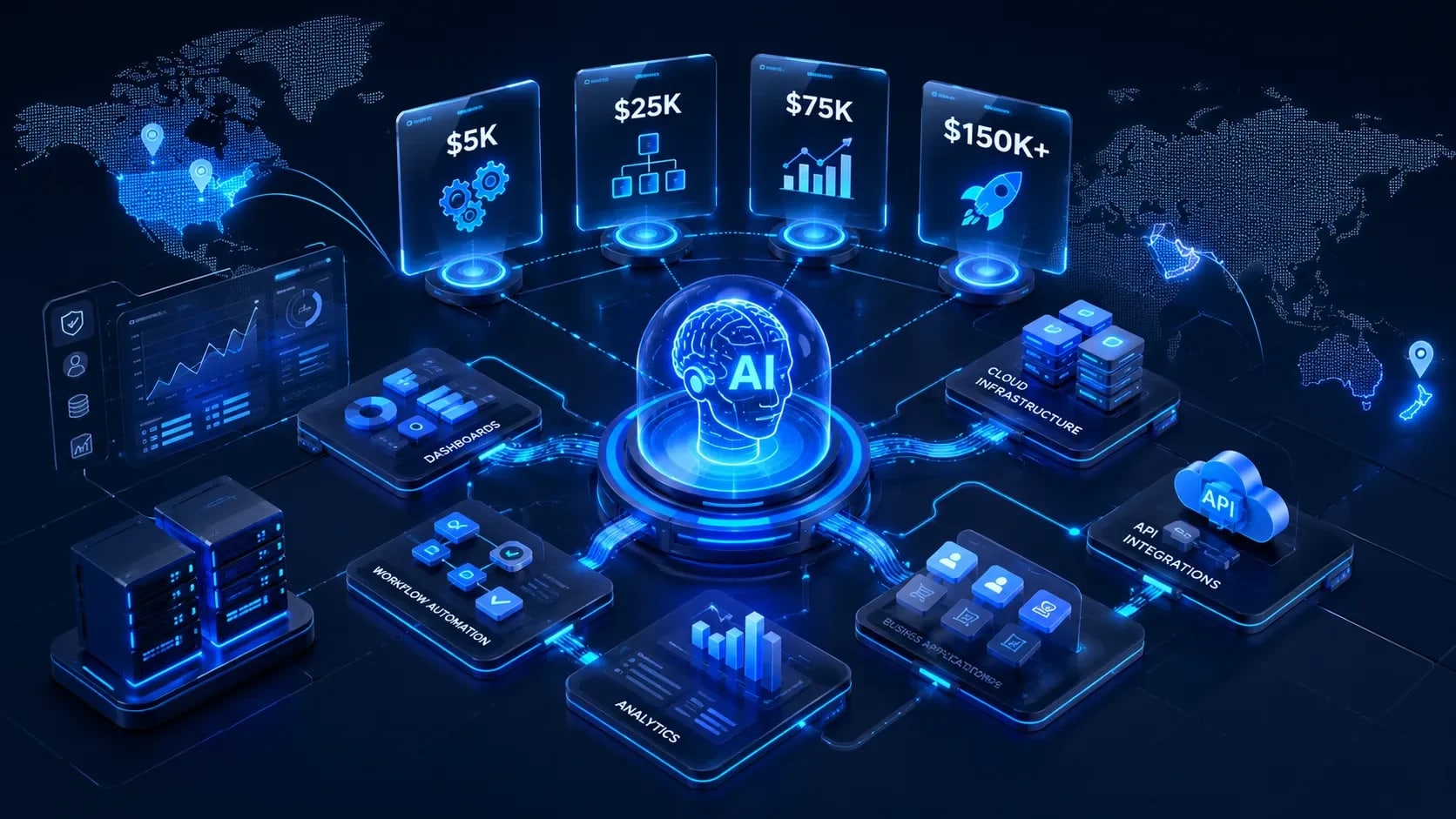
Planning to build a custom AI agent in 2026? Discover the complete cost breakdown, pricing factors, development timeline, and ROI for businesses in the USA, Canada, New Zealand, and the UAE.
Building a custom AI agent is no longer just an innovation initiative reserved for large enterprises. In 2026, businesses of every size—from fast-growing startups to established enterprises—are investing in AI agents to automate workflows, improve customer experiences, reduce operational costs, and increase productivity.
Whether you're a startup founder, SaaS business, enterprise CTO, or business owner in the USA, Canada, New Zealand, or the UAE, one question comes up before every AI project:
How much does it cost to build a custom AI agent in 2026?
The answer depends on several factors, including business requirements, AI model selection, workflow complexity, third-party integrations, security requirements, deployment infrastructure, and long-term maintenance.
While a simple AI assistant may cost only a few thousand dollars, an enterprise-grade AI agent capable of automating business operations across multiple departments requires a larger investment. More importantly, businesses should evaluate AI not just as a development expense but as a long-term investment that improves efficiency, reduces manual work, and creates measurable business value.
In this guide, we'll explain exactly what affects AI agent pricing, realistic development costs, project timelines, and what businesses should expect before investing in custom AI development.
Table of Contents
- What Is a Custom AI Agent?
- Why Businesses Are Investing in AI Agents
- AI Agent vs Traditional Chatbot
- Types of AI Agents
- Average AI Agent Development Cost in 2026
- Key Factors That Influence Pricing
- Cost Breakdown by Development Phase
- AI Development Timeline
- Pricing by Industry
- Hidden Costs
- Build In-House vs Hire an AI Development Company
- Best Practices
- Frequently Asked Questions
- Conclusion
What Is a Custom AI Agent?
A custom AI agent is an intelligent software solution designed specifically around your business processes. Unlike traditional software that follows predefined rules, AI agents understand natural language, retrieve business information, reason through complex tasks, and automate workflows with minimal human intervention.
Modern AI agents combine technologies such as:
- Large Language Models (LLMs)
- Retrieval-Augmented Generation (RAG)
- Workflow Automation
- Vector Databases
- API Integrations
- Business Logic Engines
- Knowledge Bases
These technologies enable AI agents to perform tasks such as:
- Answer customer questions
- Automate customer support
- Generate business reports
- Process invoices
- Retrieve company knowledge
- Schedule meetings
- Update CRM records
- Analyze documents
- Summarize large datasets
- Automate repetitive operational workflows
Unlike generic AI tools, a custom AI agent is built around your company's processes, making it significantly more valuable over time.
Why Businesses Are Investing in AI Agents
Artificial intelligence has become one of the highest-impact technologies for improving operational efficiency.
Instead of replacing employees, AI agents allow teams to spend less time on repetitive work and more time on strategic initiatives.
Some of the biggest benefits include:
Increased Productivity
Employees spend countless hours searching for information, replying to repetitive emails, creating reports, and updating systems.
AI agents automate these repetitive activities, allowing employees to focus on higher-value work.
Reduced Operating Costs
Businesses can significantly reduce customer support, administrative, and operational expenses through intelligent automation.
An AI agent can work 24/7 without downtime while handling thousands of interactions simultaneously.
Better Customer Experience
Customers expect instant responses.
AI agents provide:
- Immediate support
- Personalized recommendations
- Faster issue resolution
- Consistent service quality
- Multilingual communication
Improved Decision Making
AI agents can retrieve information from multiple business systems, summarize insights, identify trends, and help leadership make faster, data-driven decisions.
Business Scalability
Instead of continuously hiring staff to manage increasing workloads, businesses can scale operations using AI-powered automation while maintaining service quality.
AI Agent vs Traditional Chatbot
Although many businesses use the terms interchangeably, AI agents and traditional chatbots solve very different problems.
| Traditional Chatbot | Custom AI Agent |
|---|---|
| Rule-based conversations | Context-aware reasoning |
| Limited automation | Business workflow automation |
| Static responses | Dynamic decision making |
| Minimal integrations | Deep API integrations |
| FAQ support | End-to-end task execution |
| Cannot access business systems | Works with CRM, ERP, HRMS and other software |
| Reactive | Proactive |
For example, a chatbot might answer:
"Your invoice is pending."
An AI agent can:
- Access your accounting software
- Verify payment status
- Generate a new invoice
- Send it to the customer
- Update the CRM
- Notify the finance team
—all within a few seconds.
That level of automation is why businesses are increasingly investing in custom AI development.
Types of Custom AI Agents
Every organization has unique operational challenges, which is why AI agents are built for different business functions.
Customer Support AI Agent
Customer support AI agents automate conversations while providing fast and accurate responses.
Common capabilities include:
- Answering FAQs
- Handling support tickets
- Tracking orders
- Processing returns
- Multilingual customer support
- Escalating complex issues
Typical integrations:
- Zendesk
- Freshdesk
- HubSpot
- Salesforce
- Intercom
Sales AI Agent
Sales AI agents help revenue teams improve lead conversion by automating repetitive sales activities.
Typical responsibilities include:
- Lead qualification
- Meeting scheduling
- Personalized follow-ups
- CRM updates
- Proposal generation
- Sales forecasting
Internal Knowledge AI Agent
Knowledge management AI agents help employees quickly find information stored across multiple systems.
They retrieve data from:
- Company documentation
- HR policies
- SOPs
- Product manuals
- Internal knowledge bases
- Technical documentation
- Google Drive
- SharePoint
Instead of spending several minutes searching for information, employees receive accurate answers within seconds.
Workflow Automation AI Agent
Workflow automation agents connect multiple business systems and automate repetitive operational processes.
Examples include:
- Invoice processing
- HR onboarding
- Procurement approvals
- Report generation
- Inventory updates
- Compliance checks
- Document verification
Executive AI Assistant
Executive AI assistants are designed for business leaders.
They help executives by:
- Summarizing meetings
- Preparing reports
- Monitoring KPIs
- Tracking business performance
- Creating presentations
- Drafting executive communications
These AI assistants reduce administrative work while improving decision-making speed.
Average AI Agent Development Cost in 2026
The cost of building a custom AI agent depends entirely on your business goals and technical requirements.
Below is a realistic pricing overview.
| AI Solution | Estimated Cost (USD) |
|---|---|
| Basic AI Assistant | $5,000–$15,000 |
| Customer Support AI Agent | $15,000–$30,000 |
| Internal Knowledge AI Agent | $20,000–$45,000 |
| Workflow Automation AI Agent | $35,000–$80,000 |
| Enterprise AI Platform | $80,000–$250,000+ |
These estimates include planning, development, integrations, testing, deployment, and initial optimization.
Remember that development cost is only one part of the investment. Businesses should also evaluate the long-term operational savings, improved productivity, and increased customer satisfaction that AI agents deliver.
Key Factors That Influence AI Agent Development Cost
Every AI project is unique. Several factors directly impact the overall investment required.
1. Business Requirements
The complexity of your business processes has the biggest impact on development cost.
A customer support assistant is much simpler than an enterprise AI agent that connects multiple departments and automates complex workflows.
2. AI Model Selection
The language model you choose affects both development cost and ongoing operating expenses.
Popular options include:
- OpenAI GPT models
- Claude
- Gemini
- Open-source LLMs
Each offers different strengths in reasoning, performance, privacy, and pricing.
3. Retrieval-Augmented Generation (RAG)
Most enterprise AI agents require access to internal business knowledge.
Retrieval-Augmented Generation (RAG) enables AI agents to retrieve real-time information from:
- PDFs
- Internal documentation
- Databases
- SharePoint
- Google Drive
- Product manuals
- Knowledge bases
Although RAG improves accuracy significantly, it also increases implementation complexity.
4. Workflow Automation
Simple conversational AI requires less engineering than AI agents capable of automating complete business workflows.
Typical integrations include:
- CRM
- ERP
- Accounting software
- HRMS
- Slack
- Microsoft Teams
- Email platforms
- Payment gateways
- Custom APIs
Each integration requires authentication, testing, monitoring, and ongoing maintenance.
5. Security & Compliance
Enterprise AI deployments must protect sensitive business data.
Common security requirements include:
- Role-based access control
- Single Sign-On (SSO)
- Data encryption
- Audit logging
- GDPR compliance
- SOC 2 readiness
- HIPAA compliance
- Data residency
These requirements increase development effort but are essential for enterprise-grade AI solutions.
6. User Experience
Even the most advanced AI agent delivers little value if employees or customers struggle to use it.
A well-designed user experience often includes:
- Modern conversational interfaces
- Responsive web design
- Mobile compatibility
- Analytics dashboards
- File uploads
- Voice interaction
- Personalized user experiences
Organizations that invest in usability typically achieve faster adoption and higher long-term ROI.
Continue with Part 2, which covers the complete development cost breakdown, project timelines, pricing by region, hidden costs, ROI, common mistakes, FAQs, and a strong call to action.
AI Agent Development Cost Breakdown
Understanding where your investment goes helps you make informed decisions and avoid unexpected expenses. Below is a typical breakdown of a custom AI agent development project.
| Development Phase | Estimated Cost (USD) |
|---|---|
| Discovery & Strategy | $2,000–$8,000 |
| UI/UX Design | $3,000–$12,000 |
| AI Architecture | $5,000–$20,000 |
| Backend Development | $10,000–$40,000 |
| AI Model Integration | $5,000–$25,000 |
| RAG Implementation | $8,000–$30,000 |
| Third-Party API Integrations | $3,000–$20,000 |
| Testing & Quality Assurance | $3,000–$15,000 |
| Deployment & DevOps | $2,000–$10,000 |
| Maintenance & Optimization | Ongoing |
The final investment depends on the number of features, integrations, users, compliance requirements, and scalability goals.
AI Agent Development Timeline
Every project follows a different roadmap, but most custom AI agent development projects fall within these timelines.
| Project Type | Estimated Timeline |
|---|---|
| Basic AI Assistant | 3–5 Weeks |
| Customer Support AI Agent | 6–8 Weeks |
| Workflow Automation AI Agent | 8–12 Weeks |
| Enterprise AI Platform | 3–6 Months |
A successful AI project should never skip planning. Investing additional time in discovery often reduces development costs later by preventing expensive rework.
AI Agent Development Cost by Region
Development costs vary significantly across different markets.
| Region | Typical Project Cost |
|---|---|
| USA | $50,000–$250,000+ |
| Canada | $40,000–$180,000 |
| UAE | $30,000–$150,000 |
| New Zealand | $30,000–$120,000 |
While hourly development rates differ, businesses should focus on selecting an experienced AI development partner with proven expertise rather than choosing solely based on cost.
A poorly designed AI system often becomes more expensive to maintain than investing in quality development from the beginning.
Hidden Costs Businesses Often Overlook
Many companies budget only for development without considering long-term operational expenses.
Some common hidden costs include:
- AI API usage fees
- Cloud infrastructure
- Vector database hosting
- Monitoring and logging
- Security updates
- Model fine-tuning
- Performance optimization
- Employee training
- Maintenance
- Compliance audits
- Backup infrastructure
- Software licensing
Planning for these expenses early prevents unexpected costs after deployment.
Build an AI Agent In-House or Hire an AI Development Company?
This is one of the most common questions business leaders ask.
Building In-House
Advantages
- Complete control over development
- Internal knowledge retention
- Long-term engineering capability
Challenges
- Hiring experienced AI engineers
- Longer development timelines
- Higher recruitment costs
- Infrastructure setup
- AI expertise gaps
Hiring an AI Development Company
Advantages
- Faster delivery
- Experienced AI specialists
- Proven development process
- Lower project risk
- Ongoing support
- Scalable engineering resources
Challenges
- Choosing the right technology partner
- Clear project communication
- Well-defined project scope
For most startups and growing businesses, partnering with an experienced AI development company significantly reduces both development risk and time to market.
Best Practices Before Starting Your AI Project
Organizations that achieve the best results usually follow these best practices.
Define Clear Business Goals
Avoid building AI simply because it's trending.
Instead, identify measurable business outcomes such as:
- Reducing support costs
- Improving employee productivity
- Increasing sales conversions
- Automating repetitive processes
- Enhancing customer experience
Start Small
Instead of automating every department at once, launch a focused pilot project.
This allows teams to validate ROI before expanding AI capabilities across the organization.
Invest in High-Quality Data
AI agents are only as effective as the information they can access.
Maintain clean documentation, organized knowledge bases, and structured business data before implementation.
Prioritize Security
If your AI agent handles customer information or confidential business data, security should be integrated from day one—not treated as an afterthought.
Measure Success
Track key performance indicators such as:
- Response accuracy
- Time saved
- Customer satisfaction
- Employee productivity
- Cost reduction
- Automation rate
- ROI
Continuous monitoring helps improve your AI system over time.
Common Mistakes That Increase AI Development Costs
Many businesses unintentionally increase project costs through poor planning.
Common mistakes include:
- Starting without defined business objectives
- Choosing technology before defining requirements
- Ignoring user experience
- Underestimating integrations
- Poor documentation
- Not planning for maintenance
- Skipping security reviews
- Trying to automate every process immediately
- Selecting vendors based only on price
- Failing to measure ROI
Avoiding these mistakes can save both time and money while improving project outcomes.
Frequently Asked Questions
How much does a custom AI agent cost?
Most custom AI agent projects range from $5,000 to over $250,000, depending on complexity, integrations, security, and business requirements.
How long does AI agent development take?
Most projects take between 4 weeks and 6 months, depending on scope.
Can small businesses afford AI agents?
Yes. Many startups begin with focused AI assistants and gradually expand functionality as the business grows.
Which industries benefit the most from AI agents?
Healthcare, finance, SaaS, eCommerce, logistics, education, legal services, manufacturing, real estate, and customer support all see significant benefits from AI-powered automation.
What technologies are commonly used?
Modern AI agents often use:
- OpenAI
- Claude
- LangGraph
- LangChain
- RAG
- Vector Databases
- Node.js
- Python
- React
- Next.js
- Cloud Infrastructure
Do AI agents replace employees?
No.
The most successful businesses use AI to eliminate repetitive tasks while enabling employees to focus on higher-value work.
Can AI agents integrate with existing software?
Yes.
Custom AI agents can integrate with CRM systems, ERP platforms, HR software, accounting applications, helpdesk tools, internal databases, and custom APIs.
Is AI development secure?
Enterprise AI systems can include encryption, role-based access control, audit logging, secure authentication, and compliance with standards such as GDPR, HIPAA, and SOC 2.
Should I build or buy an AI solution?
If your business has unique workflows or competitive processes, custom AI development usually provides greater long-term value than generic off-the-shelf solutions.
How do I choose the right AI development company?
Look for a partner with proven AI expertise, strong software engineering capabilities, transparent communication, scalable architecture, and experience delivering enterprise-grade AI solutions.
Final Thoughts
Artificial intelligence is no longer an experimental technology—it's becoming a competitive advantage for businesses worldwide.
Whether you're looking to automate customer support, streamline internal operations, improve employee productivity, or build intelligent products, investing in a custom AI agent can deliver measurable long-term value.
Rather than focusing solely on the initial development cost, consider the operational savings, improved efficiency, and scalability that AI brings to your organization. A well-designed AI agent continues to generate value long after deployment by reducing manual work, accelerating decision-making, and enhancing customer experiences.
The key is partnering with an experienced AI development team that understands your business goals and builds solutions tailored to your unique workflows.
Ready to Build a Custom AI Agent?
At Futurise Solutions, we help startups, growing businesses, and enterprises design, develop, and deploy intelligent AI agents that solve real business problems.
Our expertise includes:
- Custom AI Agent Development
- AI Workflow Automation
- Enterprise AI Solutions
- RAG Implementation
- LLM Integration
- OpenAI & Claude Development
- LangGraph Development
- SaaS Product Development
- Custom Software Development
- AI Consulting
Whether you're starting your first AI initiative or scaling an enterprise automation strategy, our team can help you build secure, scalable, and business-focused AI solutions.
Book your free 45-minute AI strategy consultation today and discover how a custom AI agent can transform your business operations.
Explore More from Futurise Solutions
- AI Agent vs Traditional Chatbot
- Complete Guide to AI Consulting
- AI Automation for Small Businesses
- OpenAI vs Claude API
- LangGraph vs CrewAI
- Custom Software Development Services
- SaaS Development Services
- Contact Futurise Solutions