Custom Software Development Cost Guide 2026: Pricing, Timeline & Key Factors
Software Development · By Futurise Solutions ·
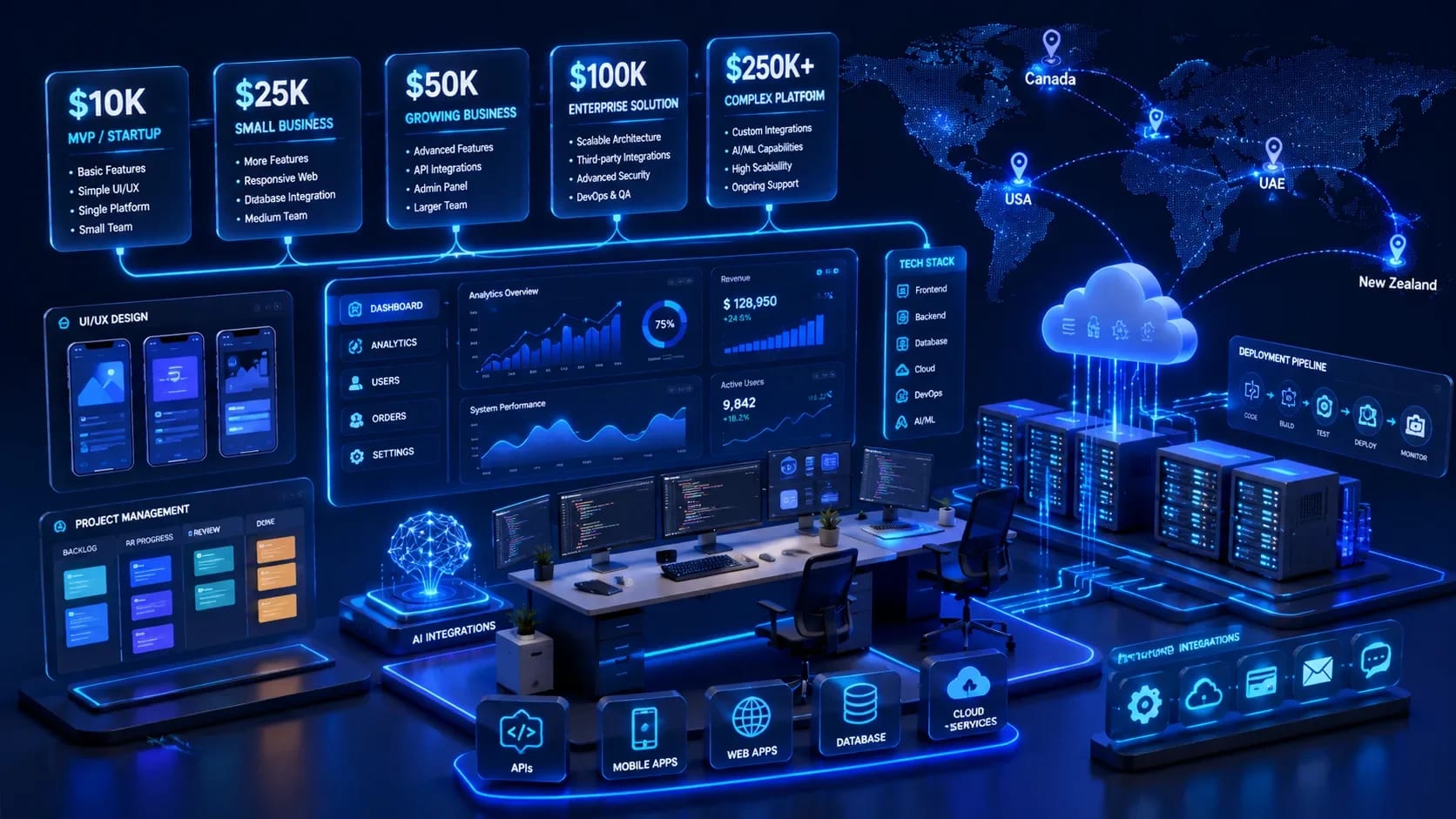
Wondering how much custom software development costs in 2026? Explore pricing, development timelines, cost factors, and how businesses in the USA, Canada, New Zealand, and UAE can budget for custom software projects.
Every growing business eventually reaches a point where off-the-shelf software is no longer enough.
Maybe your team is juggling multiple spreadsheets, switching between disconnected tools, or manually handling repetitive tasks that slow productivity. Off-the-shelf solutions may solve part of the problem, but they rarely fit your business perfectly.
That's why more companies are investing in custom software development.
Whether you're building a CRM, ERP, SaaS platform, marketplace, internal business portal, mobile application, or enterprise automation system, one question always comes first:
How much does custom software development cost in 2026?
The answer depends on several factors, including project complexity, features, integrations, technology stack, security requirements, scalability, and the development team you choose.
In this guide, we'll break down everything you need to know—from software development pricing and timelines to hidden costs, budgeting tips, and how businesses across the USA, Canada, New Zealand, and UAE can maximize their return on investment.
Table of Contents
- What Is Custom Software Development?
- Why Businesses Choose Custom Software
- Types of Custom Software
- Factors That Affect Development Cost
- Software Development Cost by Project Type
- Typical Development Timeline
- Build vs Buy
- Frequently Asked Questions
- Conclusion
What Is Custom Software Development?
Custom software development is the process of designing, developing, and maintaining software built specifically for a business's unique requirements.
Unlike off-the-shelf software, custom solutions are tailored to your workflows, customers, employees, and long-term business goals.
Examples include:
- Customer Relationship Management (CRM)
- Enterprise Resource Planning (ERP)
- Inventory Management Systems
- Healthcare Portals
- Learning Management Systems
- Real Estate Platforms
- SaaS Applications
- Booking Platforms
- Marketplace Applications
- AI-Powered Business Platforms
Instead of adapting your business to existing software, custom software adapts to your business.
Businesses looking to create scalable digital products often combine custom software with our Web Development Services and App Development Services to build complete web and mobile ecosystems.
Why Businesses Invest in Custom Software
As businesses grow, managing operations with spreadsheets and disconnected tools becomes increasingly inefficient.
Custom software helps organizations:
- Automate repetitive tasks
- Improve employee productivity
- Centralize business data
- Reduce manual errors
- Improve customer experience
- Integrate existing software
- Scale operations efficiently
- Increase business visibility through real-time reporting
Rather than paying monthly subscriptions for multiple disconnected platforms, businesses often invest in one centralized solution tailored to their needs.
Common Types of Custom Software
Enterprise Software
Large organizations use enterprise software to manage operations across departments.
Examples include:
- ERP Systems
- HRMS
- Financial Management
- Procurement Platforms
- Compliance Systems
SaaS Applications
Software-as-a-Service platforms allow businesses to deliver cloud-based products to customers through subscription models.
Examples include:
- CRM Platforms
- Project Management Tools
- Accounting Software
- Healthcare Platforms
- Learning Platforms
If you're planning a SaaS product, our SaaS Platform Scale Case Study demonstrates how scalable architecture supports long-term business growth.
Internal Business Portals
Companies build internal portals for:
- Employee Management
- Document Sharing
- Knowledge Bases
- Approval Workflows
- Performance Tracking
These systems improve collaboration while reducing administrative overhead.
Mobile Applications
Many businesses build custom Android and iOS applications alongside their web platforms.
Mobile apps are commonly used for:
- Customer Self-Service
- Booking Platforms
- Delivery Management
- Healthcare
- Retail
- FinTech
Learn more about our App Development Services for cross-platform mobile applications.
AI-Powered Software
Modern software increasingly includes AI capabilities.
Examples include:
- AI Assistants
- AI Agents
- Document Analysis
- Customer Support Automation
- Predictive Analytics
- Workflow Automation
If you're exploring AI-powered products, our AI & ML Solutions explain how intelligent automation can be integrated into modern software.
What Determines Custom Software Development Cost?
Every software project is unique.
Several factors directly influence pricing.
1. Project Complexity
A simple internal dashboard costs significantly less than an enterprise platform with thousands of users.
Complex projects require:
- More planning
- Additional developers
- Advanced architecture
- Extensive testing
- Higher security standards
2. Features & Functionality
The number of features has a direct impact on development cost.
Typical features include:
- Authentication
- User Roles
- Dashboards
- Reports
- Notifications
- Payments
- Search
- Analytics
- File Uploads
- API Integrations
- AI Features
The more custom functionality required, the larger the development effort.
3. UI/UX Design
An intuitive user interface improves adoption and customer satisfaction.
Professional UI/UX design includes:
- User Research
- Wireframes
- Interactive Prototypes
- Responsive Design
- Accessibility
- Design Systems
Explore our UI/UX Design Services to see how thoughtful design improves software usability and engagement.
4. Technology Stack
The technologies chosen for your project influence development speed, scalability, and long-term maintenance.
Common technologies include:
- React
- Next.js
- Node.js
- Express.js
- MongoDB
- PostgreSQL
- AWS
- Azure
- Docker
- Kubernetes
Selecting the right technology stack helps reduce future maintenance costs while improving performance.
5. Third-Party Integrations
Most modern software connects with existing business systems.
Examples include:
- Stripe
- Razorpay
- HubSpot
- Salesforce
- Xero
- Google Workspace
- Microsoft 365
- Slack
- QuickBooks
- Twilio
Each integration requires planning, testing, authentication, and ongoing maintenance.
6. Security & Compliance
Enterprise software often requires advanced security measures such as:
- Multi-Factor Authentication
- Role-Based Access Control
- Data Encryption
- Audit Logs
- GDPR Compliance
- HIPAA Compliance
- SOC 2 Readiness
These features increase development effort but are essential for protecting sensitive business data.
Estimated Software Development Cost
The following table provides a realistic pricing overview for common software projects.
| Software Type | Estimated Cost (USD) |
|---|---|
| Business Website | $5,000–$15,000 |
| Customer Portal | $15,000–$40,000 |
| CRM / ERP System | $30,000–$100,000 |
| Marketplace Platform | $40,000–$150,000 |
| SaaS Application | $50,000–$250,000+ |
| Enterprise Software | $100,000–$500,000+ |
These estimates vary based on project requirements, integrations, scalability, and long-term maintenance needs.
If you're also evaluating AI-powered business software, don't miss our guide on How Much Does It Cost to Build a Custom AI Agent in 2026? to understand how AI impacts software development costs.
Typical Software Development Timeline
Most projects follow these phases:
| Phase | Estimated Duration |
|---|---|
| Discovery & Planning | 1–3 Weeks |
| UI/UX Design | 2–4 Weeks |
| Development | 8–24 Weeks |
| Testing & QA | 2–6 Weeks |
| Deployment | 1–2 Weeks |
Timelines vary depending on project complexity, team size, and client feedback cycles.
Hidden Costs Businesses Often Overlook
When planning a software project, many businesses only budget for development. However, there are several ongoing costs that should be considered before starting.
Some of the most common hidden costs include:
- Cloud hosting and infrastructure
- Domain and SSL certificates
- Third-party API subscriptions
- Software licensing
- Security monitoring
- Performance optimization
- Regular backups
- Bug fixes and maintenance
- Feature enhancements
- Technical support
- DevOps and deployment
- Database management
Understanding these costs early helps businesses create a realistic budget and avoid unexpected expenses after launch.
Build Custom Software or Buy Existing Software?
Many companies struggle with the decision of whether to purchase an existing solution or invest in custom software.
Here's a quick comparison.
| Feature | Off-the-Shelf Software | Custom Software |
|---|---|---|
| Initial Cost | Lower | Higher |
| Monthly Subscription | Yes | Usually No |
| Customization | Limited | Unlimited |
| Scalability | Limited | Excellent |
| Ownership | No | Yes |
| Integrations | Limited | Fully Custom |
| Competitive Advantage | Low | High |
| Long-Term ROI | Moderate | Excellent |
Off-the-shelf software works well for generic business needs.
However, if your business has unique workflows, plans to scale, or requires deep integrations, custom software provides significantly greater long-term value.
Software Maintenance Costs
Launching software is only the beginning.
Regular maintenance ensures your application remains secure, scalable, and compatible with evolving technologies.
Typical maintenance includes:
- Security updates
- Performance improvements
- Server monitoring
- Bug fixes
- Feature enhancements
- Database optimization
- API updates
- Cloud infrastructure management
Many businesses allocate 15–25% of the initial development cost annually for maintenance and continuous improvements.
Common Mistakes Businesses Make
Many software projects exceed their budget because of poor planning rather than technical challenges.
Avoid these common mistakes:
- Starting development without clear requirements
- Choosing the cheapest development partner
- Ignoring scalability
- Skipping UI/UX planning
- Underestimating testing
- Not planning integrations
- Ignoring long-term maintenance
- Poor communication during development
- Frequently changing project scope
- Delaying user feedback until launch
Planning your project carefully before development begins helps reduce costs and improve delivery timelines.
Best Practices Before Starting a Custom Software Project
Successful software projects usually follow these best practices:
Define Clear Business Goals
Identify the business problem you're solving before discussing technology.
Build an MVP First
Launching a Minimum Viable Product (MVP) helps validate your idea before investing in advanced functionality.
Choose the Right Technology Partner
Look beyond hourly rates.
Choose a software development company with experience in architecture, scalability, security, and long-term support.
Prioritize User Experience
Great software is not only functional—it should also be intuitive and enjoyable to use.
Our UI/UX Design Services help businesses create user-friendly products that improve engagement and retention.
Plan for Growth
Build software that can scale with your business instead of rebuilding it every few years.
Frequently Asked Questions
How much does custom software development cost?
Most projects range from $10,000 to over $500,000, depending on features, complexity, integrations, and scalability.
How long does software development take?
A typical custom software project takes between 3 and 9 months, depending on the scope and requirements.
Is custom software better than off-the-shelf software?
If your business has unique workflows, long-term growth plans, or requires integrations with multiple systems, custom software usually provides a better return on investment.
Can custom software include AI features?
Absolutely.
Modern applications often include AI-powered capabilities such as intelligent chatbots, AI agents, predictive analytics, document processing, and workflow automation.
Learn more about our AI & ML Solutions and how AI can enhance modern software products.
Which industries benefit from custom software?
Custom software is widely used in:
- Healthcare
- Finance
- SaaS
- Real Estate
- Education
- Manufacturing
- Retail
- Logistics
- Professional Services
Why Businesses Choose Futurise Solutions
At Futurise Solutions, we help startups, SMEs, and enterprises transform ideas into scalable digital products.
Our expertise includes:
- Custom Web Development
- Mobile App Development
- AI & ML Solutions
- UI/UX Design
- Blockchain Development
- Digital Marketing
We build secure, scalable, and future-ready software solutions for businesses across the USA, Canada, New Zealand, UAE, and beyond.
Want to see our work?
Explore our Portfolio to discover how we've helped businesses launch successful digital products.
You can also read our SaaS Platform Scale Case Study and FinTech UX Redesign Case Study to see how we've delivered measurable business outcomes.
Ready to Build Custom Software That Grows With Your Business?
Whether you're building an MVP, enterprise platform, SaaS application, customer portal, or AI-powered software, choosing the right development partner makes all the difference.
Our team at Futurise Solutions combines strategy, design, engineering, and AI expertise to deliver software that solves real business problems and scales with your growth.
🚀 Book a Free 45-Minute Strategy Call
Need to discuss your project first?
Or visit our Homepage to explore our complete range of software development, AI, mobile app development, UI/UX design, blockchain, and digital marketing services.
Related Articles
- How Much Does It Cost to Build a Custom AI Agent in 2026?
- AI Agent vs Traditional Chatbot: Which One Does Your Business Really Need in 2026?
- AI Automation for Small Businesses in New Zealand
- Web Development Services: Fast, Scalable, and SEO-Ready Websites
- App Development Services: Build Cross-Platform iOS and Android Apps
- AI & ML Solutions: How Custom AI Agents, LLMs, NLP, and Computer Vision Are Transforming Modern Businesses
Explore more technology insights on the Futurise Solutions Blog.