On this page
Blockchain Development Services: What to Build and What to Check
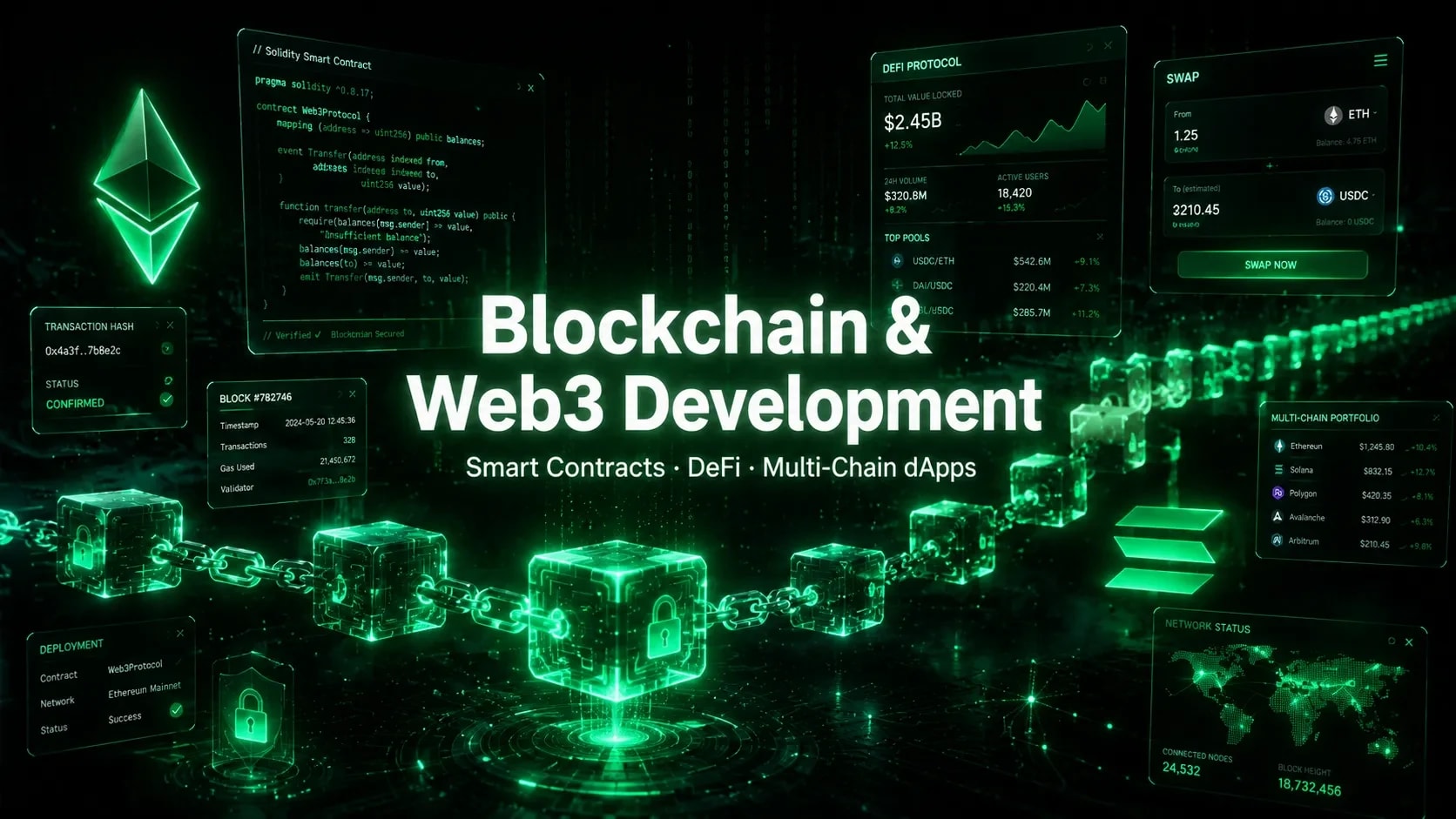
This guide is for founders and businesses that want to add blockchain features to a product or launch a Web3 project, and need to know what is realistic. Good blockchain development services start with a narrow question: which part of your product genuinely needs a chain? In most practical cases the answer is one of a few well-understood builds, such as an NFT mint, token staking, a token launch, or crypto payments inside an otherwise normal app.
Below: those builds, how to choose a chain, what security work to budget for, and what timelines are realistic. We are a software team, not a financial adviser, and nothing here is legal or investment guidance.
Practical Web3 builds that businesses actually commission
NFT minting sites
An NFT mint combines a smart contract with a website where users connect a wallet, pay and receive a token. The contract decides supply, price, allowlists and royalties. The front end handles wallet connection (WalletConnect and similar), transaction status and error states. We have built a mint dApp on this model. The tricky parts are rarely the contract itself. They are metadata hosting, handling failed transactions clearly for the user, and keeping the mint page working under a traffic spike.
Staking and rewards
Time-locked staking lets holders lock tokens for a period and earn rewards. It looks simple on a diagram and is easy to get wrong in code: reward maths, lock durations, early-withdrawal rules and what happens when the reward pool runs dry all need explicit decisions. We have built a time-locked staking system with rewards, and the most useful work happens before coding, when we write down every rule and edge case.
Token creation on Solana and EVM chains
Creating a token on Solana (an SPL token) or on an EVM chain (an ERC-20) is technically straightforward. The harder questions are around supply, distribution, who holds mint authority, and the legal treatment of your token in the markets you serve. We have built SPL token minting. Get legal advice early, because the regulatory classification of a token varies by country.
Crypto payments inside a normal product
For many businesses this is the most useful category. You do not need a protocol; you need to accept crypto at checkout or pay out in it. We have added crypto payments to a car-rental platform. The work is mostly payment confirmation, handling underpaid or late transactions, price conversion, refunds and accounting records. If your team does not want to hold keys, a payment processor may be a better fit than a custom build.
Dashboards and trading interfaces
Interfaces that show on-chain or exchange data need careful real-time design. Our portfolio includes a crypto perpetuals terminal for GDT Exchange. For a wider look, see the Web3 dApp development page and the DeFi protocol launch case study.
Working on something like this? Talk it through with the team that builds it.
Choosing a chain
| Chain type | Typical use | Notes |
|---|---|---|
| Ethereum mainnet | High-value assets, established DeFi | Highest security profile and the highest transaction fees |
| EVM layer 2s and sidechains (Base, Arbitrum, Polygon and others) | Consumer apps, mints, low-fee payments | Lower fees; confirm each network's bridge and finality assumptions |
| Solana | Fast, low-cost token and consumer apps | Different programming model (Rust); separate tooling from EVM |
| Private or permissioned chains | Enterprise record-keeping | Often a database would do the job; check whether you need a chain at all |
Choose on four things: where your users already hold funds, the transaction costs your product can tolerate, the quality of wallets and tooling, and the support from auditors and exchanges. Do not pick a chain because it is trending.
Security and audits
Smart contracts are public and often immutable, which makes bugs expensive. A sound process includes:
- Written specification before any code, covering every rule and edge case.
- Well-tested building blocks. Use audited libraries such as OpenZeppelin for standard contracts instead of writing everything from scratch.
- Automated tests with high coverage, plus fuzzing for anything holding value.
- Testnet deployment and a staged rollout with caps.
- An independent audit for any contract that holds user funds. Audits find problems but do not guarantee safety, so budget time for fixes and a re-review.
- Key management. Use hardware wallets or multisig for admin keys, and document who can do what.
- Upgrade and pause plans. Decide before launch whether the contract can be upgraded or paused, and who controls that power.
Be sceptical of any agency that says it can build a contract holding significant value without an external audit.
Regional and regulatory points
Rules differ by market, so take advice from a qualified local adviser. In the United States, the treatment of tokens and payment services depends on how the product works and who it serves. In the UAE, the federal rules sit alongside local regimes, and Dubai has a dedicated regulator for virtual assets (VARA). Our Web3 dApp development page for the UAE covers how we work with clients in that market. For tokenised real-world assets, see our post on real-world asset tokenisation.
Realistic timelines
These are typical for us, depending on scope: a focused dApp such as a mint or simple staking contract and front end often fits within an MVP window of 6 to 12 weeks, including testing. Larger platforms with several contracts, back-office tools and integrations take 3 to 6 months. Audit scheduling can add weeks, so book your auditor early.
How to choose a blockchain development partner
- Ask to see deployed contracts or live dApps and read them on a block explorer.
- Ask how they test, and who audits.
- Ask how they would handle a bug found after launch.
- Ask who holds admin keys and what the recovery plan is.
- Confirm you will own the repository, contracts and deployment keys.
- Walk away from guaranteed returns, promises of token price performance, or requests to build systems designed to deceive other traders.
Frequently asked questions
Do I need a blockchain for my product?
Only if you need shared, tamper-resistant records between parties who do not trust one another, or you need to work with existing crypto assets. If one company controls the data, a normal database is simpler, cheaper and faster.
How much does a smart contract audit cost?
It varies widely with the size and complexity of the code, and quotes differ between firms, so we do not give a figure here. Ask two or three auditors to quote on your actual contracts, and plan for a fix-and-recheck cycle.
Do you build trading or sniping bots?
No. We build products such as mints, staking, payments and dashboards, not tools designed to exploit other traders.
If you're weighing a Web3 build or adding crypto payments, book a free discovery call and we'll help you choose a chain, scope the contracts and plan the audit.
Written by the Futurise Solutions team. We use AI tools to help with research and drafting; our team edits each article and checks figures and regulatory details against the sources linked in it. Spotted something wrong? Email us.